You Changed the AI Model. How Do You Know It Got Better?
A better demo doesn't mean a better system. Production AI changes need an evaluation suite — a regression test for model behavior — measured across quality, safety, latency, and cost together.
- Production Lessons
- AI Evaluation
- AI Architecture
- LLM
- AI Systems
You changed the model. Or the prompt. Or the retrieval strategy. The new version looked better in your own testing, so you shipped it. A week later someone asks: did we actually improve the system? And you realize you don't really know.
That's one of the harder problems in production AI. Traditional software gives you a fairly clean regression test: input → expected output → pass or fail. AI rarely has one perfect answer, so a change can improve one thing while quietly making another worse. Model V1 might run at 82% accuracy, a 6% hallucination rate, and 1.2s latency. Model V2 pushes accuracy to 87% — but hallucinations climb to 10% and latency to 2.1s. Did V2 get better? It depends entirely on what you're optimizing for.
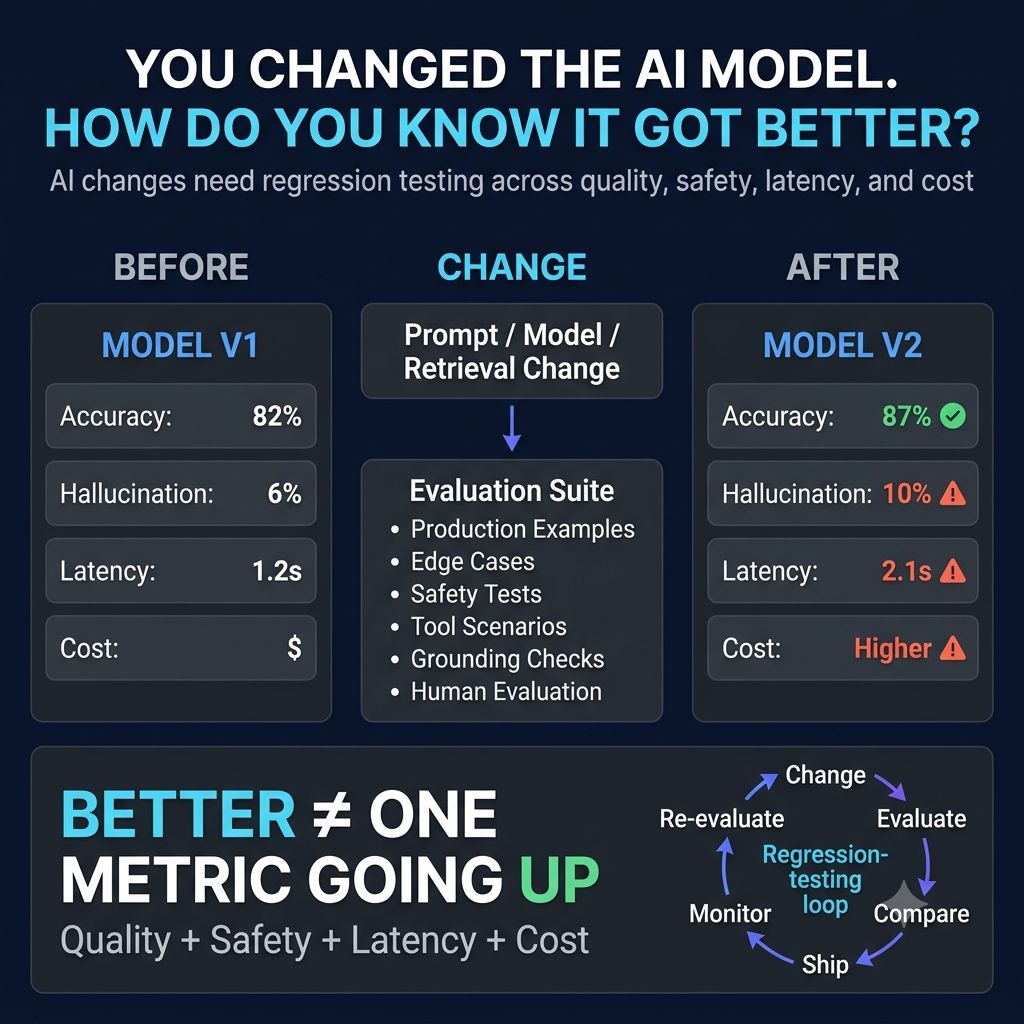
That's why serious AI teams build an evaluation suite — effectively a regression test suite for model behavior. It should cover real production examples, edge cases, known failure cases, safety tests, tool-use scenarios, grounding checks, and human evaluation, all compared against the same baseline every time something changes. A better demo doesn't necessarily mean a better system.
There's a second trap: optimizing one metric in isolation. A system can get more accurate while becoming too expensive, safer while becoming unusably slow, or faster while producing worse answers. Production AI is an optimization problem across quality, safety, latency, and cost together — which is why the right question isn't "does the new model look better?" but "what changed across the whole system?"
One principle worth keeping: If you can't measure the regression, you can't confidently ship the improvement.
How are you measuring whether an AI change actually improved your production system?
Keep reading
Why Can't You Test an AI System Like a Normal API?
A normal API gives the same input the same output every time. Ask an AI system the same question twice and the answer can differ — or look completely correct and still be wrong.
Why Your AI Application Needs More Than Just an LLM
"User → API → LLM → Response" is simple, elegant, and incomplete — production AI applications need an orchestrator, tools, memory, guardrails, and observability wrapped around the model.
Why Giving an AI Agent More Tools Can Make It Less Reliable
An agent with 50 tools sounds more capable than one with 5, but every extra tool is another way to fail — and another failure boundary the system has to bound, validate, and recover from.