Why Your AI Application Needs More Than Just an LLM
"User → API → LLM → Response" is simple, elegant, and incomplete — production AI applications need an orchestrator, tools, memory, guardrails, and observability wrapped around the model.
- Architecture Breakdown
- AI Architecture
- AI Systems
- LLM
- System Design
A lot of AI architecture diagrams look like this: User → API → LLM → Response. Simple. Elegant. And incomplete — because production AI applications rarely work like that.
Imagine a user asks: "Analyze our Q3 sales performance and tell me what changed." The system may need to authenticate the user, understand the request, retrieve relevant company data, select the right context, call an LLM, potentially use tools, validate the output, stream the response, record telemetry, and apply security and usage limits. The LLM is only one part of the system.
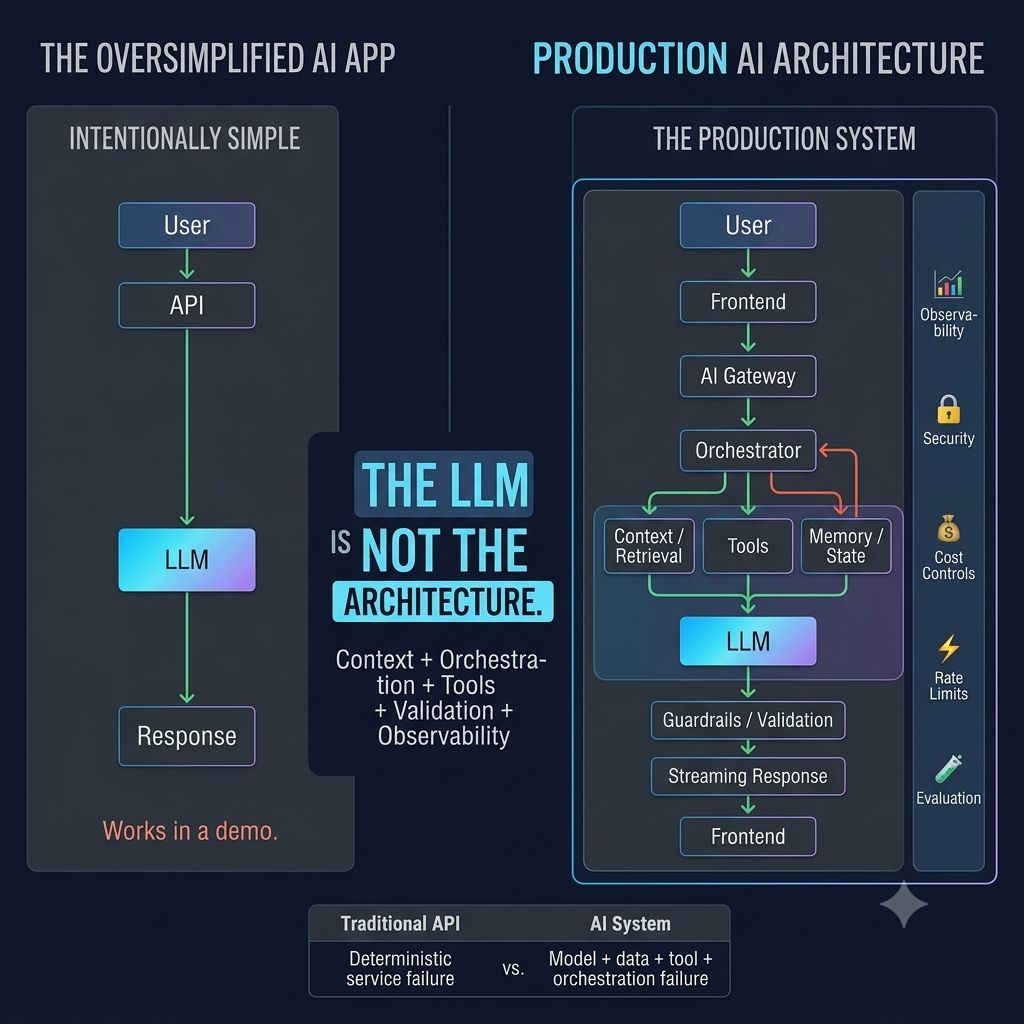
A more realistic architecture looks like: User → Frontend → AI Gateway / API → Orchestrator, which fans out to Context, Tools, and Memory, feeds into the LLM, passes through Guardrails / Validation, and returns a Streaming Response back to the Frontend. Around all of this sit observability, security, cost controls, rate limiting, and evaluation.
That's the architectural shift many teams underestimate. You're not simply adding an LLM to an application — you're building a distributed system where one component can make probabilistic decisions. That changes the failure model. A normal API might fail because the service is down. An AI system can fail because the model misunderstood the request, the retrieved context was wrong, the tool returned stale data, the model selected the wrong tool, or the output was technically valid but operationally useless.
That's why production AI architecture is becoming less about "which model should we use?" and more about "how do we build a reliable system around the model?"
One principle I strongly believe in: The LLM should be treated as a component — not the architecture.
The strongest AI systems won't necessarily be the ones with the biggest model. They'll be the ones with the best context, orchestration, tools, validation, and observability around it. That's where traditional software architecture suddenly becomes extremely relevant to AI.
What would you consider the most important component around an LLM in a production system?
Keep reading
Why Can't You Test an AI System Like a Normal API?
A normal API gives the same input the same output every time. Ask an AI system the same question twice and the answer can differ — or look completely correct and still be wrong.
Why Does ChatGPT Need So Many Steps to Answer One Question?
A one-sentence prompt feels like question → AI → answer, but a production AI request is really understand → retrieve → decide → act → validate → respond — and every step can add latency, cost, or failure.
Why Your Dashboard Can Say "Healthy" While Your Users Can't Use the Product
CPU normal, memory normal, error rate 0.2% — and support says users can't check out. Why infrastructure health and user experience are measured by different questions.