Why Giving an AI Agent More Tools Can Make It Less Reliable
An agent with 50 tools sounds more capable than one with 5, but every extra tool is another way to fail — and another failure boundary the system has to bound, validate, and recover from.
- Production Lessons
- AI Agents
- AI Architecture
- Agentic AI
- Production AI
An AI agent with 50 tools sounds more capable than one with 5. But there's a problem: more tools also mean more ways to fail.
Imagine an engineering agent with access to GitHub, Jira, Slack, CI/CD, databases, cloud infrastructure, monitoring, and production APIs. The capability looks impressive, but now the agent has to decide which tool to use and when to use it. A wrong decision can create unnecessary tool calls, higher latency, higher token cost, incorrect actions, security exposure, and harder debugging — and the failures can compound.
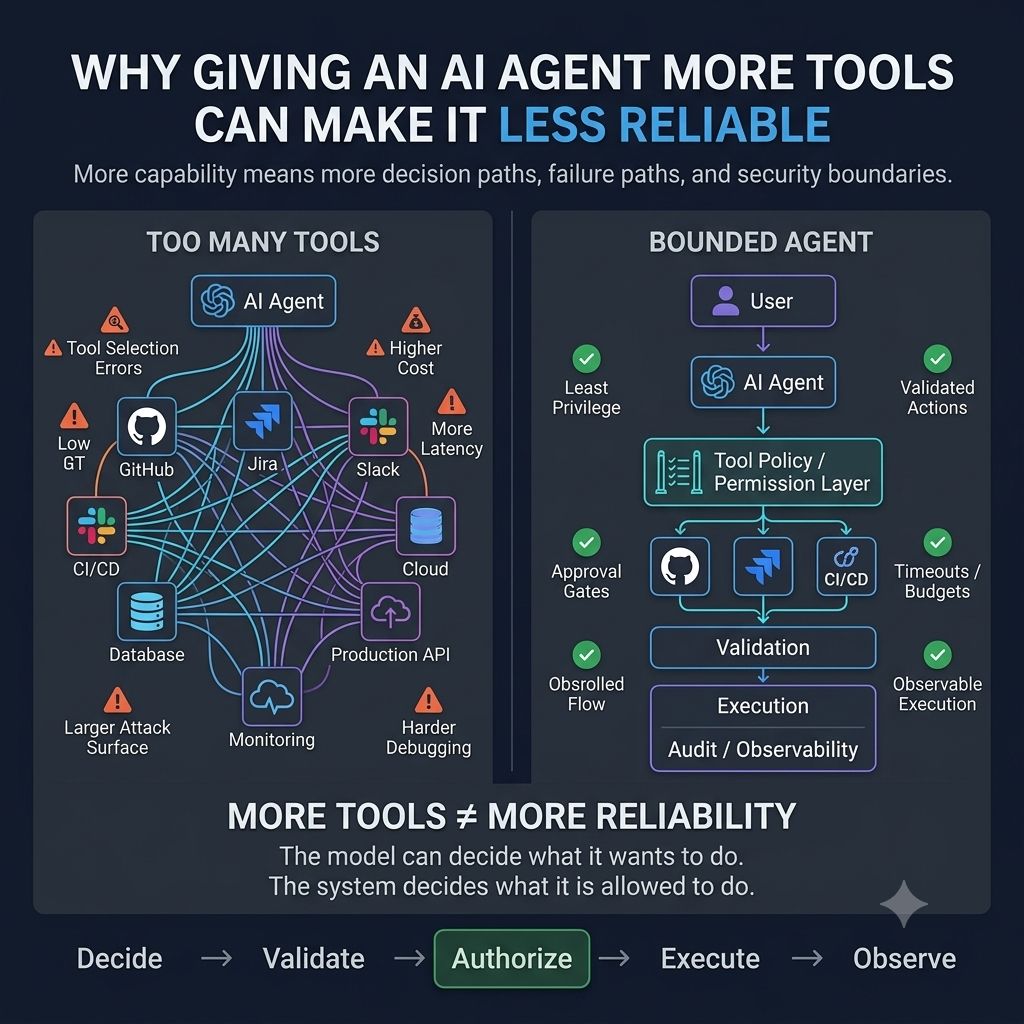
A simple workflow — User → Agent → Tool → Result — can quickly become User → Agent → Tool → Agent → Tool → Agent → Tool → Result. Every additional step introduces another failure boundary.
That's why production agent architecture needs constraints: limit available tools by task, validate tool arguments, enforce permissions outside the model, require approval for high-impact actions, set timeouts and budgets, make actions idempotent where possible, log every tool invocation, and provide recovery paths.
The important distinction: The model can decide what it wants to do. The system should decide what it is allowed to do.
That becomes even more important when agents can modify real systems — deleting a Jira ticket is recoverable, deleting production data isn't. So the right question isn't "how many tools can our agent use?" It's "what is the smallest capability surface that lets it complete the task safely?"
That's how I think about production AI. More autonomy isn't automatically better — good architecture makes autonomy bounded, observable, and recoverable.
Where would you draw the boundary between an AI agent making a decision and the system allowing that decision to execute?
Keep reading
How Does an AI Coding Agent Know What Code to Change?
"Add dark mode to this application" isn't prompt → LLM → code — a coding agent sits inside an orchestration loop of discovery, retrieval, planning, tool calls, tests, and feedback before anything ships.
Why Can't You Test an AI System Like a Normal API?
A normal API gives the same input the same output every time. Ask an AI system the same question twice and the answer can differ — or look completely correct and still be wrong.
Why Your AI UI Can't Behave Like a Normal API
A traditional API is request → wait → response → render. An AI UI has to handle streaming tokens, tool calls, cancellation, and reconnection — because it's coordinating with a stateful, asynchronous backend process.