Why Can't You Test an AI System Like a Normal API?
A normal API gives the same input the same output every time. Ask an AI system the same question twice and the answer can differ — or look completely correct and still be wrong.
- Architecture Breakdown
- AI Evaluation
- AI Architecture
- AI Systems
- LLM
A normal API gives you the same input and expects the same output, so testing can look like Input → Expected Output → Pass/Fail. AI systems are different. Ask the same question twice and you might get slightly different answers. Worse — the answer can look completely correct and still be wrong.
That's one of the biggest architectural challenges with production AI.
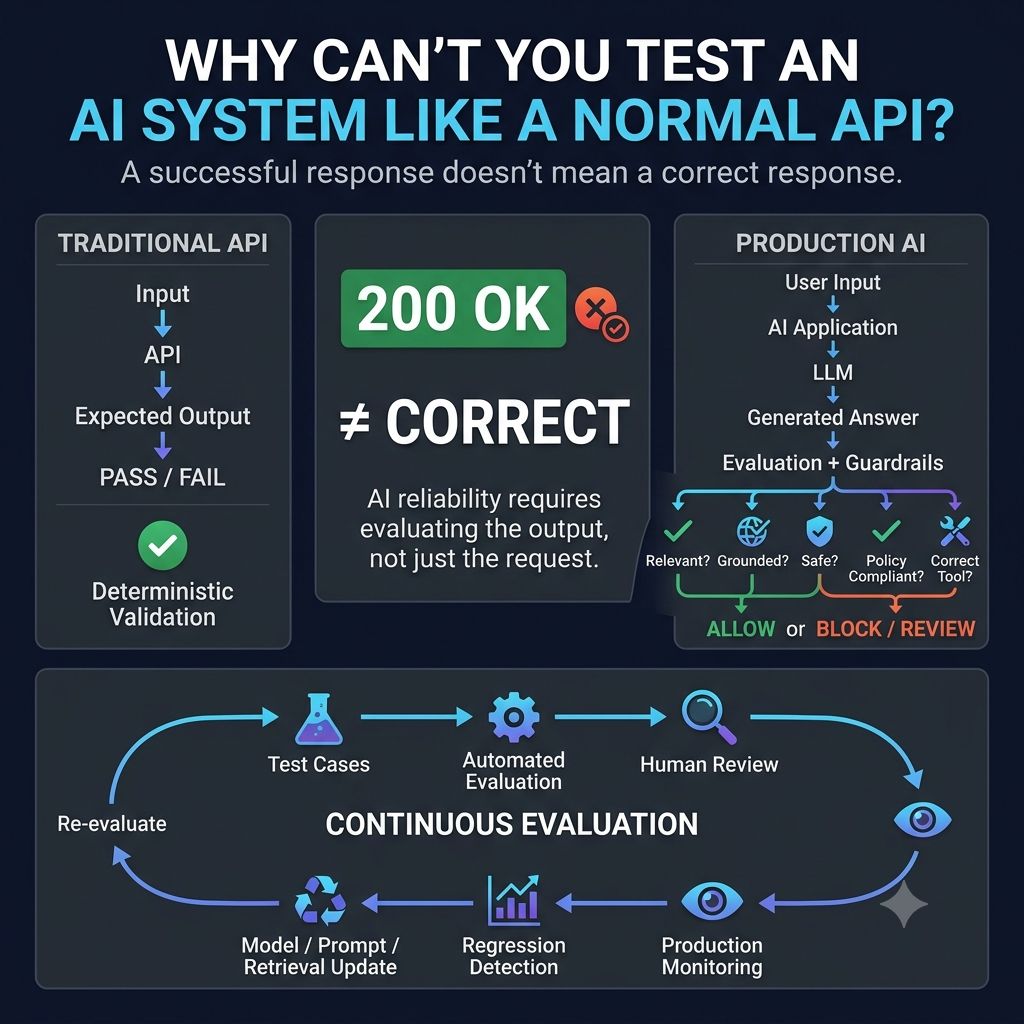
Imagine an internal engineering assistant. You ask: "How do I deploy this service?" The model gives a confident answer — the API returns 200 OK, latency is excellent, no exceptions, your monitoring dashboard is completely green. But the instructions are outdated. Technically: system healthy. Operationally: system failed.
That's why AI reliability needs another layer. A production AI system needs to evaluate more than "did the request succeed?" It needs to ask: was the answer relevant, was the information grounded in trusted data, did the model follow the required policy, did it use the correct tool, did it expose sensitive information, did it produce a safe action?
This creates a different architecture: User → AI Application → LLM → Evaluation / Guardrails → Response or Block.
And evaluation shouldn't happen only after production incidents. Teams need representative test cases, automated evaluations, human review, and continuous monitoring — because with AI, "it worked yesterday" isn't enough. A model update, a prompt change, a retrieval change, or a new tool can all change behavior. The system around the model needs to detect those changes.
One principle I strongly believe in: AI quality needs to become an engineering signal, not a subjective opinion.
Don't just measure latency, availability, and error rate. Also measure whether the system gave the right answer. That's the shift from building an AI demo to operating an AI system.
How would you define "correct" for an AI system where there isn't always one perfect answer?
Keep reading
Why Your AI Application Needs More Than Just an LLM
"User → API → LLM → Response" is simple, elegant, and incomplete — production AI applications need an orchestrator, tools, memory, guardrails, and observability wrapped around the model.
Why Does ChatGPT Need So Many Steps to Answer One Question?
A one-sentence prompt feels like question → AI → answer, but a production AI request is really understand → retrieve → decide → act → validate → respond — and every step can add latency, cost, or failure.
How Does an AI Coding Agent Know What Code to Change?
"Add dark mode to this application" isn't prompt → LLM → code — a coding agent sits inside an orchestration loop of discovery, retrieval, planning, tool calls, tests, and feedback before anything ships.