Why Does ChatGPT Need So Many Steps to Answer One Question?
A one-sentence prompt feels like question → AI → answer, but a production AI request is really understand → retrieve → decide → act → validate → respond — and every step can add latency, cost, or failure.
- System Design Explained
- AI Systems
- AI Architecture
- RAG
- System Design
You type one sentence — "Summarize the latest sales report and tell me what changed" — and a few seconds later you get an answer. It feels like Question → AI → Answer. But a production AI system may be doing much more.
A simplified request looks like: User → API / AI Gateway → Request Validation → Context Retrieval → Prompt / Context Assembly → LLM → Tool Calls (if needed) → Validation / Guardrails → Streaming Response → User. The interesting part? The LLM isn't necessarily doing all the work.
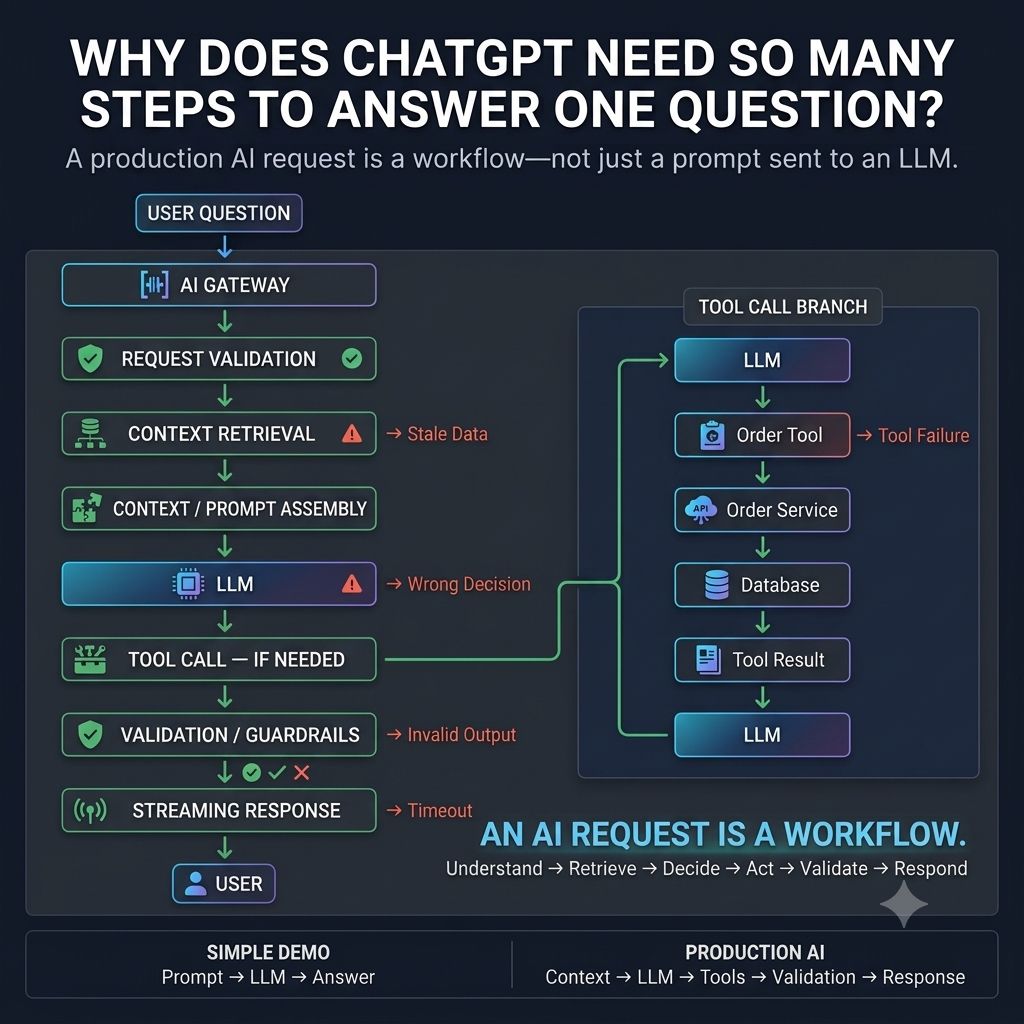
Imagine the question requires information from your company's internal systems. The system needs to identify what information is required, retrieve the relevant data, put that data into the model's context, and generate an answer. Sometimes the model needs to take an action too — "Cancel my order" can turn into User → LLM → Order Tool → Order Service → Database → Result → LLM → User.
That's no longer a simple request-response API — it's a workflow, and workflows introduce architecture problems: what happens if the tool fails, if the retrieved data is stale, if the model calls the wrong tool, if the request takes 10 seconds, if the user disconnects halfway through, if the model generates an invalid action? These aren't just AI problems — they're distributed-systems problems with a probabilistic component.
A production AI request isn't "send a prompt to an LLM." It's understand → retrieve → decide → act → validate → respond, and every step can introduce latency, cost, failure, and security risk.
One architectural principle I keep coming back to: The model should make decisions within boundaries defined by the system.
The architecture should control what context the model receives, which tools it can access, what actions require validation, what happens when something fails, and how the result reaches the user. The model is powerful, but the surrounding architecture determines whether that power is safe and useful in production.
Would you trust an AI agent to directly modify production data without a validation layer?
Keep reading
Why Your AI Application Needs More Than Just an LLM
"User → API → LLM → Response" is simple, elegant, and incomplete — production AI applications need an orchestrator, tools, memory, guardrails, and observability wrapped around the model.
Why Can't You Test an AI System Like a Normal API?
A normal API gives the same input the same output every time. Ask an AI system the same question twice and the answer can differ — or look completely correct and still be wrong.
Why Does One Slow Service Make Your Whole App Feel Slow?
An API that "responds in 1.8 seconds" is rarely slow on its own — distributed tracing breaks a request into spans to show which dependency actually spent the time.