How Does an AI Coding Agent Know What Code to Change?
"Add dark mode to this application" isn't prompt → LLM → code — a coding agent sits inside an orchestration loop of discovery, retrieval, planning, tool calls, tests, and feedback before anything ships.
- Real System Deep Dive
- AI Coding
- AI Agents
- AI Architecture
- Software Engineering
You tell an AI coding agent: "Add dark mode to this application." It doesn't magically understand your entire codebase — it has to figure it out.
A simplified workflow looks like: Developer Request → Repository Discovery (which files matter?) → Context Retrieval (what existing patterns should it understand?) → Planning (what needs to change?) → Tool Calls (read files, search code, edit files, run commands) → Tests (does the change actually work?) → Feedback (if something fails, inspect, modify, test again) → Final Change.
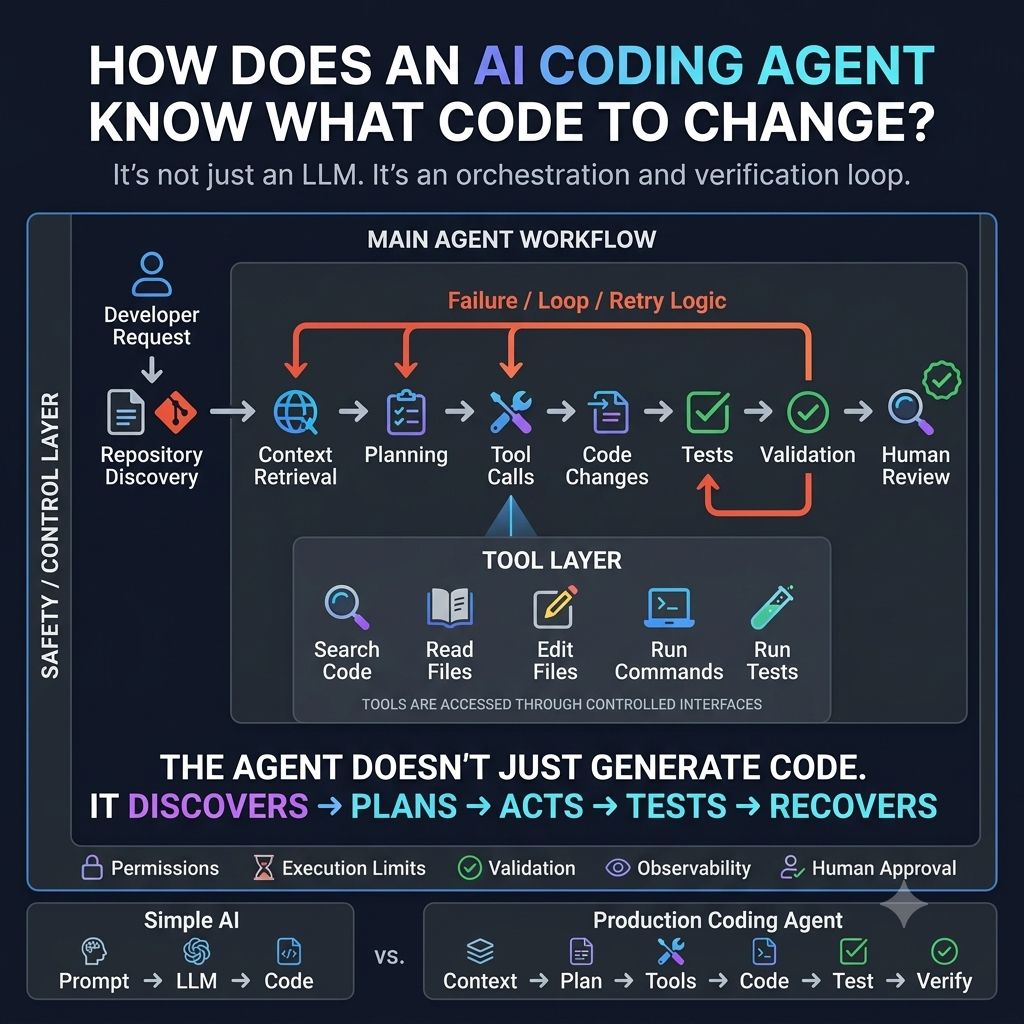
That's fundamentally different from Prompt → LLM → Code. The model isn't operating in isolation — it's sitting inside an orchestration loop, and that creates some interesting architecture problems. What happens when the agent retrieves the wrong files? What if it misunderstands the existing architecture? What if a tool call fails? What if the generated code compiles but breaks a critical workflow? What if the agent keeps trying the same fix?
That's why a production coding agent needs more than a powerful model. It needs context management, tool permissions, execution limits, validation, tests, observability, recovery, and human review.
There's an important distinction: The agent can propose a change. The system should verify the change.
That's why tests and validation become even more important as AI writes more code. The interesting future isn't "AI replaces software engineers" — it's "software engineers become the architects of systems where AI performs parts of the implementation loop." The hard engineering problem shifts from "can the model write code?" to "can we build a reliable system around the model that knows what context to use, what actions are allowed, and how to verify the result?"
That's a much more interesting architecture problem.
Would you let an AI coding agent merge directly into production without human approval?
Keep reading
Why Giving an AI Agent More Tools Can Make It Less Reliable
An agent with 50 tools sounds more capable than one with 5, but every extra tool is another way to fail — and another failure boundary the system has to bound, validate, and recover from.
Why Can't You Test an AI System Like a Normal API?
A normal API gives the same input the same output every time. Ask an AI system the same question twice and the answer can differ — or look completely correct and still be wrong.
Why Your AI UI Can't Behave Like a Normal API
A traditional API is request → wait → response → render. An AI UI has to handle streaming tokens, tool calls, cancellation, and reconnection — because it's coordinating with a stateful, asynchronous backend process.