Why Does Your AI Coding Agent Need to Understand Your Whole Codebase?
An AI coding agent can add role-based access, pass its tests, and still violate the authorization architecture already sitting around it — because writing code is easy, and knowing where it belongs is harder.
- System Design Explained
- AI Coding
- AI Architecture
- Software Architecture
- System Design
Ask an AI coding agent to add role-based access to a feature, and it will find the component, write the code, and pass the tests. Looks good — until you discover the application already has RBAC rules, shared authorization utilities, tenant-level permissions, and API-level enforcement, and the AI's change works locally but violates the architecture around it.
That's the problem with AI coding at scale: writing code is easy, understanding where that code belongs is harder. A coding agent needs context before it needs more tokens, and a useful pipeline looks like task, repository discovery, architecture and dependency mapping, relevant files, existing patterns, tests and contracts, then implementation. The step before implementation is the one that matters — the agent needs to know where business logic lives, which modules own which state, which APIs are authoritative, which abstractions already exist, which dependencies are allowed, and which tests define expected behavior.
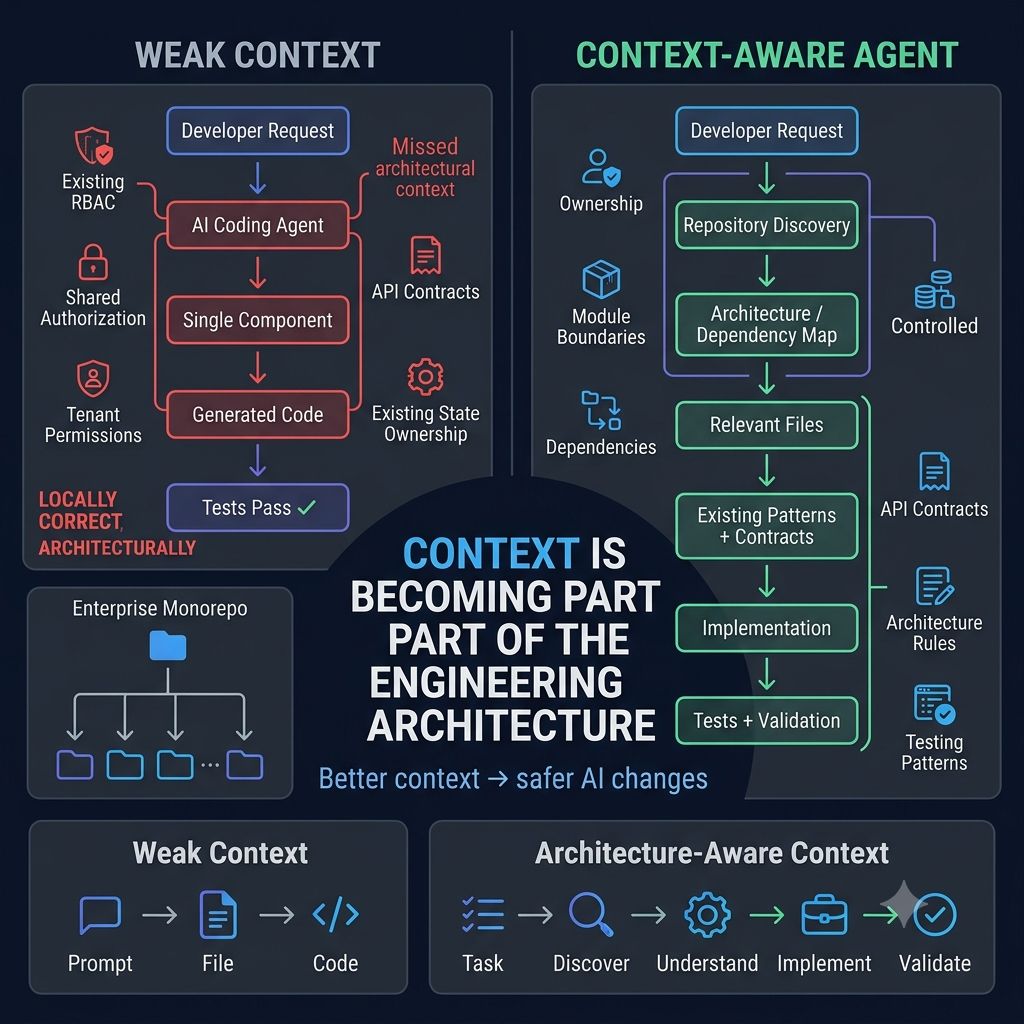
Skip that step, and the agent can produce something locally correct but architecturally wrong. It gets more important as repositories grow: a 20-file project can survive weak context, but a multi-team monorepo with hundreds of packages can't. At that scale, AI coding needs architecture-aware context — ownership, boundaries, dependencies, and conventions, together with contracts.
The real question isn't "how do we make AI generate more code?" It's "how do we make AI understand enough of the system to change the right code?" — because faster generation without better context just creates technical debt faster.
One principle I strongly believe in: Context is becoming part of the engineering architecture.
How much of your codebase does an AI coding agent actually understand before it starts making changes?
Keep reading
What If Your AI Didn't Need to Generate Text?
The usual AI pipeline — prompt in, text out — breaks down the moment your application needs a decision instead of a paragraph. A typed-question approach can replace an entire generation-and-parsing pipeline.
How Does an AI Coding Agent Change a Massive Codebase Without Breaking Everything?
Changing one file is easy; changing a massive codebase safely is a completely different problem. The biggest risk isn't obviously bad code — it's reasonable code landing in the wrong place, hundreds of times over.
Why AI Can Write Code Faster but Make Architecture More Important
A feature that once took a day can now ship in minutes, which sounds like architecture matters less. The opposite is true — when code gets cheaper to produce, bad architecture gets cheaper to produce too.