Why AI Can Write Code Faster but Make Architecture More Important
A feature that once took a day can now ship in minutes, which sounds like architecture matters less. The opposite is true — when code gets cheaper to produce, bad architecture gets cheaper to produce too.
- Architecture Breakdown
- AI Coding
- Software Architecture
- AI Architecture
- System Design
AI can generate code in seconds, and a feature that once took a day can sometimes ship in minutes. The obvious question is whether that makes architecture less important. I think the opposite is happening: when code becomes cheaper to produce, bad architecture becomes cheaper to produce too.
An AI assistant can generate components, APIs, tests, services, database queries, and integrations very quickly — but it doesn't automatically know whether this logic should live here, who owns this state, whether a dependency will create coupling six months from now, or whether something belongs in the frontend or the backend. In a large frontend without clear boundaries, that makes it incredibly easy to add one more shared utility, one more API wrapper, one more abstraction, one more state layer. Each change looks reasonable; the system slowly becomes harder to reason about.
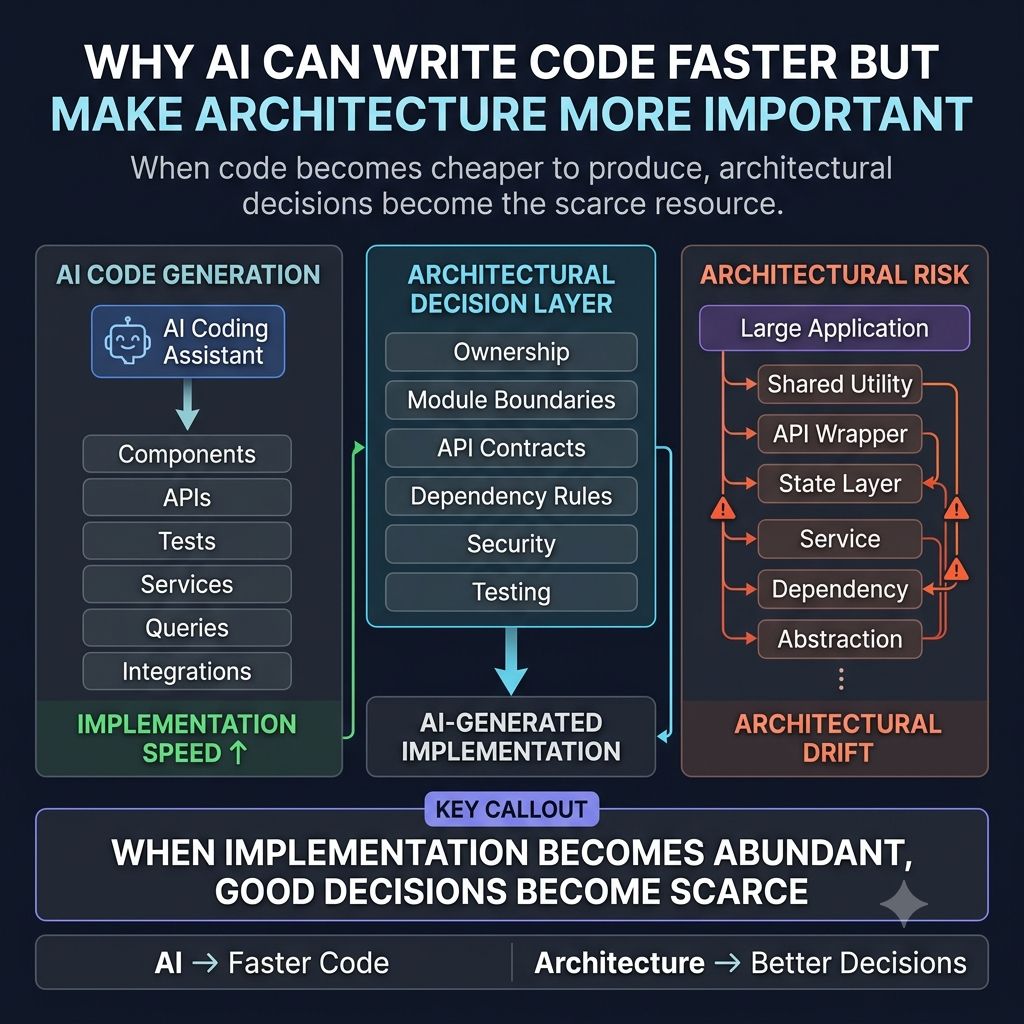
AI can accelerate implementation without accelerating architectural understanding, which is why AI-native engineering needs stronger guardrails around ownership, module boundaries, API contracts, dependency rules, testing strategy, and security policies. The engineer's role shifts accordingly — less "how quickly can I write this code" and more "what should exist in the first place."
When implementation becomes abundant, good decisions become the scarce resource. AI makes coding cheaper; that makes architecture more valuable, not less.
One principle worth keeping: When implementation becomes abundant, good architectural decisions become the scarce resource.
Do you think AI-assisted development will make technical architecture more important, or less?
Keep reading
Why Are We Using Chat Models to Make Decisions?
Classify something, route something, score a risk — for years the answer has been "ask the LLM," then parse and validate the text it hands back. That mismatch gets expensive in production.
How Does an AI Coding Agent Change a Massive Codebase Without Breaking Everything?
Changing one file is easy; changing a massive codebase safely is a completely different problem. The biggest risk isn't obviously bad code — it's reasonable code landing in the wrong place, hundreds of times over.
Why Does Your AI Coding Agent Need to Understand Your Whole Codebase?
An AI coding agent can add role-based access, pass its tests, and still violate the authorization architecture already sitting around it — because writing code is easy, and knowing where it belongs is harder.