How Does an AI Coding Agent Change a Massive Codebase Without Breaking Everything?
Changing one file is easy; changing a massive codebase safely is a completely different problem. The biggest risk isn't obviously bad code — it's reasonable code landing in the wrong place, hundreds of times over.
- Real System Deep Dive
- AI Coding
- AI Architecture
- Software Architecture
- System Design
Changing one file is easy. Changing a massive codebase safely is a completely different problem. If an AI coding agent receives "add multi-tenant permissions to the reporting module," it shouldn't immediately start editing files — a safer workflow looks like understand, discover, plan, change, validate, review.
Context comes first. The agent needs to discover the relevant modules, existing permission patterns, shared services, API contracts, tests, and dependency boundaries before it builds a plan — and the plan should answer "what parts of the architecture should change," not just "which file should I edit." Only then should it start modifying code, moving through tool permissions, code changes, static analysis, tests, architecture checks, a pull request, and human review.
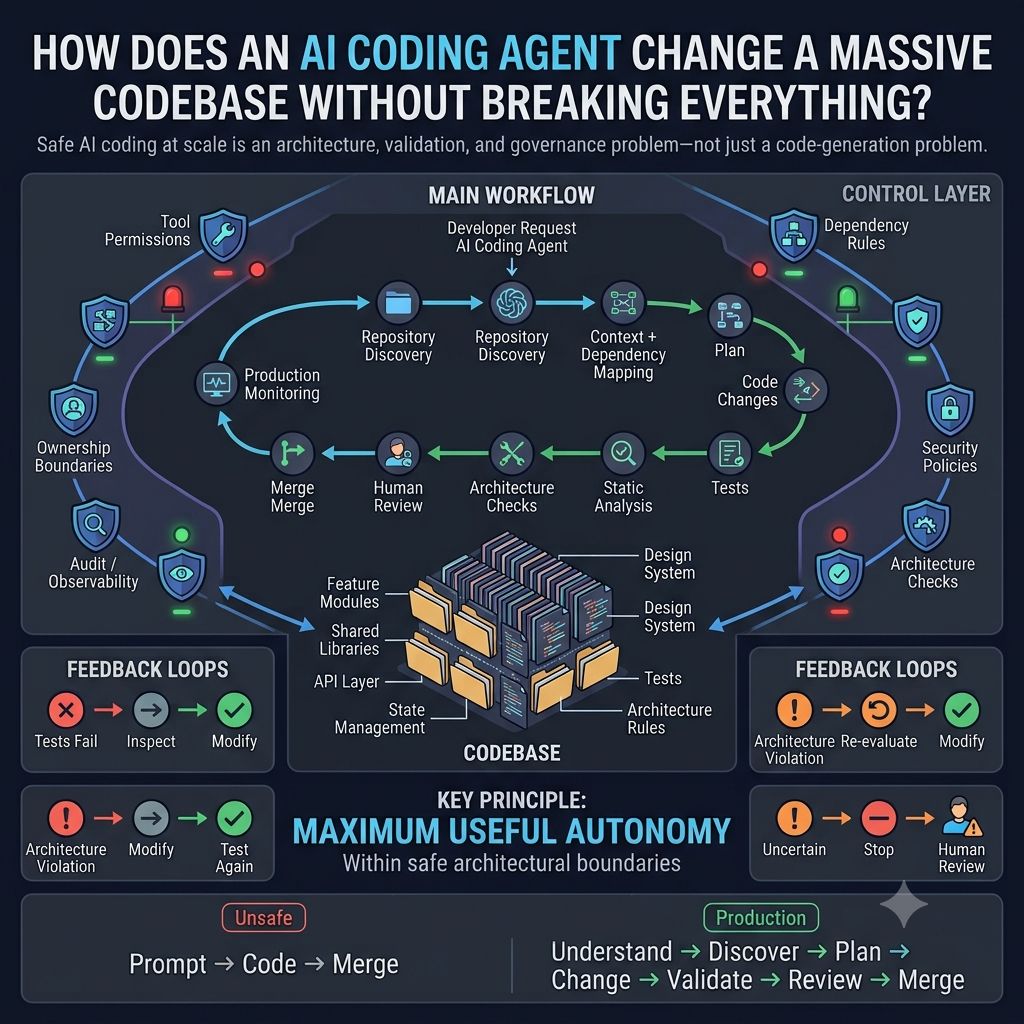
The interesting part is the feedback loop: if tests fail, the agent inspects, modifies, and tests again; if architecture checks fail, it re-evaluates, changes, and validates again; if it can't confidently resolve the issue, it stops and escalates. That's very different from prompt, code, merge, and the difference becomes critical at scale.
The biggest risk in a large repository usually isn't obviously bad code — it's reasonable code in the wrong place. A duplicate API layer, a second state-management pattern, a dependency crossing a team boundary — each change looks harmless on its own, but together they create architectural drift. That's why AI coding at scale is a governance and feedback-loop problem before it's a code-generation problem: the system needs to make good changes easy and bad architectural changes difficult.
One principle worth keeping: The goal isn't maximum AI autonomy — it's maximum useful autonomy within safe architectural boundaries.
Would you let an AI agent make changes across a large monorepo without automated architecture checks in the loop?
Keep reading
Why Does Your AI Coding Agent Need to Understand Your Whole Codebase?
An AI coding agent can add role-based access, pass its tests, and still violate the authorization architecture already sitting around it — because writing code is easy, and knowing where it belongs is harder.
Why AI Can Write Code Faster but Make Architecture More Important
A feature that once took a day can now ship in minutes, which sounds like architecture matters less. The opposite is true — when code gets cheaper to produce, bad architecture gets cheaper to produce too.
What If Your AI Didn't Need to Generate Text?
The usual AI pipeline — prompt in, text out — breaks down the moment your application needs a decision instead of a paragraph. A typed-question approach can replace an entire generation-and-parsing pipeline.