What If Your AI Didn't Need to Generate Text?
The usual AI pipeline — prompt in, text out — breaks down the moment your application needs a decision instead of a paragraph. A typed-question approach can replace an entire generation-and-parsing pipeline.
- System Design Explained
- AI Architecture
- System Design
- AI Agents
- Software Architecture
We usually think about AI as input, prompt, LLM, text, application — and that works beautifully when the user actually needs text. But what if the application needs a decision instead? A support system receiving "I've contacted you three times and I'm still waiting" doesn't need a paragraph back — it needs to know whether the customer is frustrated, what type of request this is, how severe it is, and whether it should be escalated.
Generating that paragraph was never really the hard part. The hard part is producing reliable signals that software can act on, and that creates two very different architectures. The traditional one looks like state, prompt, LLM, generated text, parse, validate, business logic, where every translation step is another failure boundary. A decision-oriented approach looks like state, typed question, structured decision, application code.
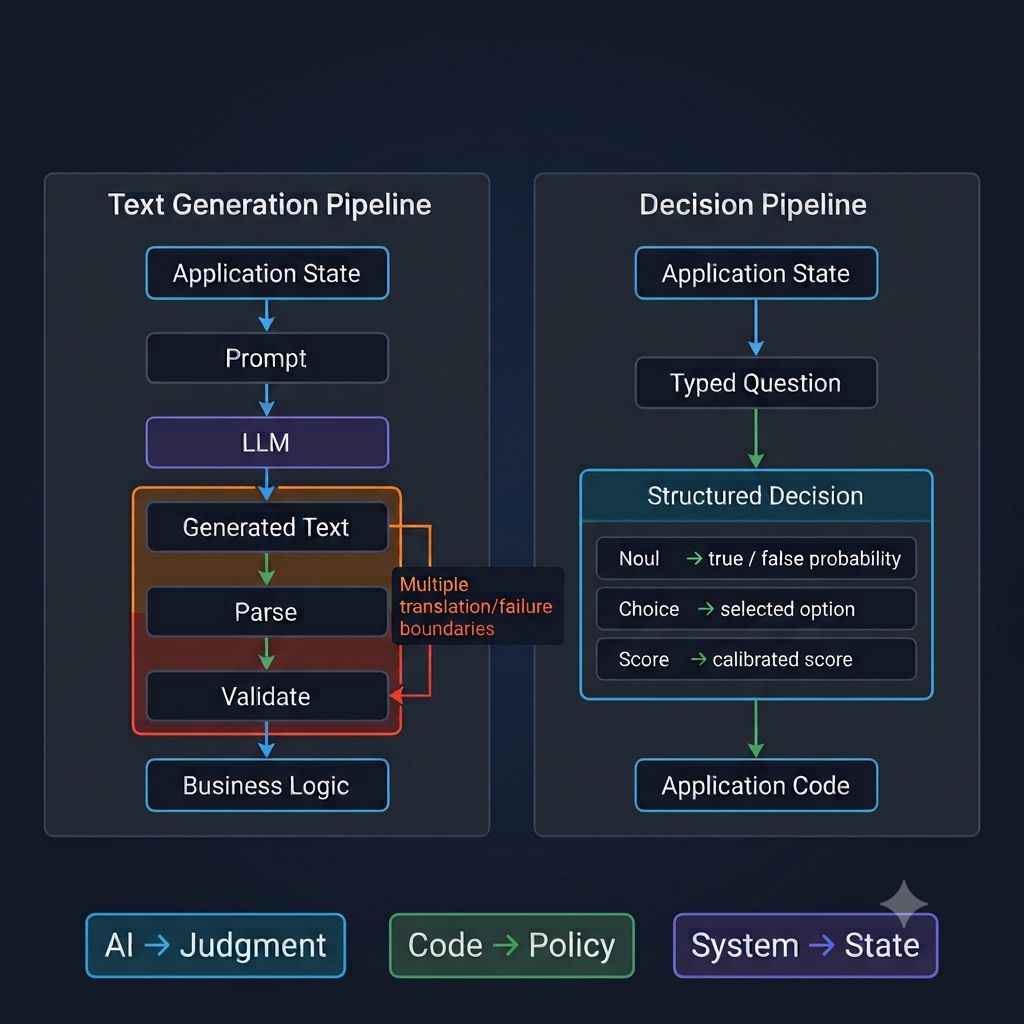
That's the architectural idea behind TypeSafe's Jev: instead of asking a model to explain its judgment in natural language, you ask narrowly scoped questions and get back structured results — a yes/no, a choice among options, a score against a rubric. The part worth noticing is that the application still owns the decision policy. Jev can report that frustration scores 0.91; your code decides what 0.91 means — maybe that's a human-review threshold, maybe it's a priority escalation. Those thresholds are business decisions, not model decisions.
That separation is the point: AI provides judgment, code provides policy, systems provide state, and humans provide oversight where uncertainty matters. The more interesting question stops being "how do I get an LLM to return the right JSON?" and becomes "what kind of intelligence does this part of my architecture actually need?"
One principle worth keeping: Not every AI interaction needs a paragraph back — some of them just need an answer.
Where in your architecture could a structured decision replace an entire LLM text-generation-and-parsing pipeline?
Keep reading
Why Are We Using Chat Models to Make Decisions?
Classify something, route something, score a risk — for years the answer has been "ask the LLM," then parse and validate the text it hands back. That mismatch gets expensive in production.
Why Does Your AI Coding Agent Need to Understand Your Whole Codebase?
An AI coding agent can add role-based access, pass its tests, and still violate the authorization architecture already sitting around it — because writing code is easy, and knowing where it belongs is harder.
How Does an AI Coding Agent Change a Massive Codebase Without Breaking Everything?
Changing one file is easy; changing a massive codebase safely is a completely different problem. The biggest risk isn't obviously bad code — it's reasonable code landing in the wrong place, hundreds of times over.