The Fastest Way to Create Technical Debt? Let AI Write Code Without Guardrails
AI can make a team dramatically faster, but shipped-code volume isn't the same as engineering velocity — technical debt from AI-assisted development shows up at the system level, months after it looked fine locally.
- Production Lessons
- AI Coding
- Software Architecture
- Technical Debt
- System Design
AI can make a team dramatically faster, but there's a dangerous assumption hiding behind that speed: more code shipped doesn't automatically mean more engineering velocity. A team using AI to accelerate development can look great for months — features ship quickly, PRs open faster, tests get generated — and then, six months later, the codebase is carrying more duplicated logic, more abstractions, more dependencies, more inconsistent patterns, and more code nobody wants to touch. The team didn't slow down; the codebase did.
That's the hidden risk of AI-assisted development: AI is very good at producing a solution that works locally, but technical debt is usually created at the system level. One extra API wrapper doesn't look dangerous. One new state pattern doesn't look dangerous. One new utility doesn't look dangerous. Multiply that across hundreds of AI-assisted changes, and you have architectural drift.
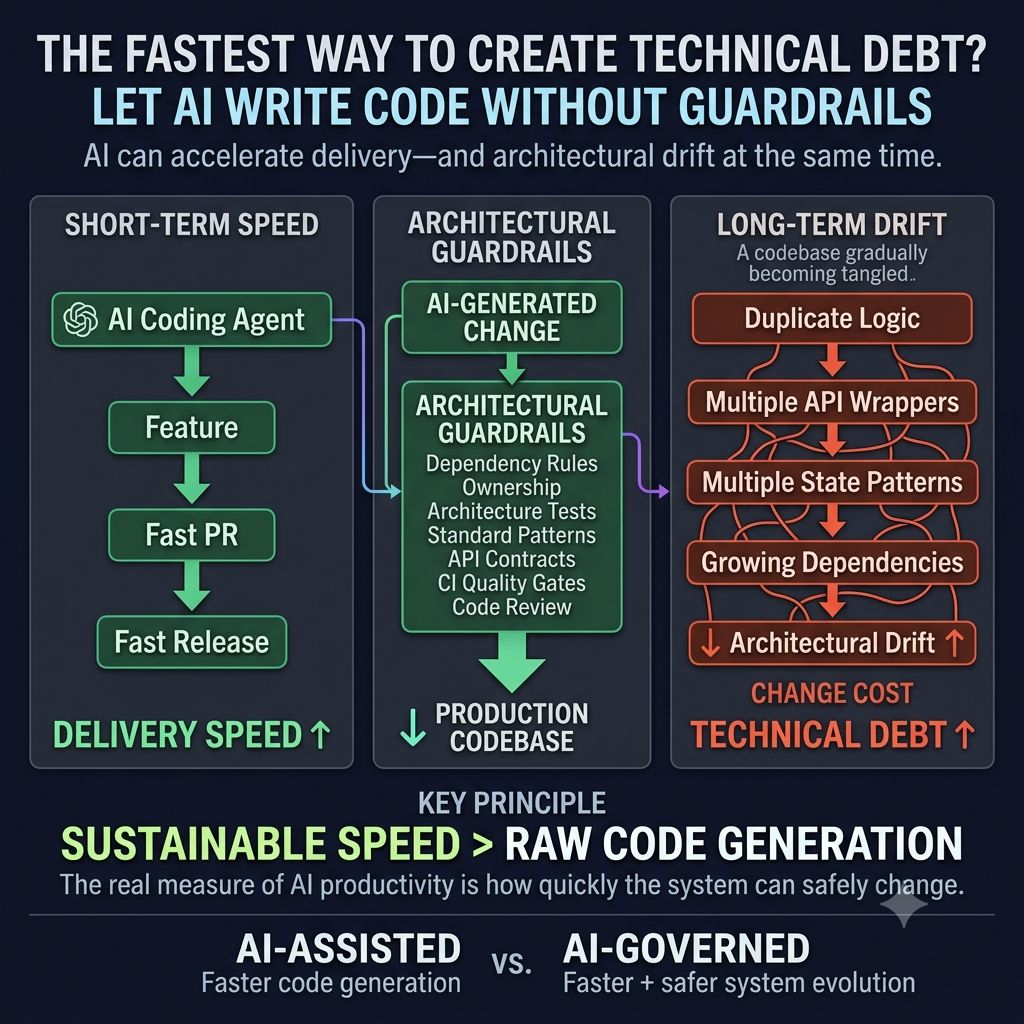
That's why AI adoption needs engineering guardrails: dependency rules, ownership boundaries, architecture tests, standard patterns, API contracts, CI quality gates, and code review. The goal was never "don't let AI write code" — it's "don't let AI bypass architectural constraints."
That distinction separates AI-assisted development from AI-governed development. The first optimizes for speed; the second optimizes for sustainable speed — because the fastest team today isn't necessarily the one shipping the most code, it's the one that can still change the codebase quickly six months from now. That's the real test of engineering velocity.
One principle worth keeping: Measure AI productivity by how quickly the system can safely change, not by lines of code shipped.
Would you measure AI productivity by lines of code shipped, or by how quickly the system can safely change?
Keep reading
How Does an AI Coding Agent Change a Massive Codebase Without Breaking Everything?
Changing one file is easy; changing a massive codebase safely is a completely different problem. The biggest risk isn't obviously bad code — it's reasonable code landing in the wrong place, hundreds of times over.
Why Does AI-Generated Frontend Code Get Messy So Fast?
AI can build a React component or wire up an API integration in seconds, yet an AI-assisted frontend can get harder to maintain just as fast — because AI protects the problem you gave it, not the architecture around it.
Why Does Your AI Coding Agent Need to Understand Your Whole Codebase?
An AI coding agent can add role-based access, pass its tests, and still violate the authorization architecture already sitting around it — because writing code is easy, and knowing where it belongs is harder.