Why Does AI-Generated Frontend Code Get Messy So Fast?
AI can build a React component or wire up an API integration in seconds, yet an AI-assisted frontend can get harder to maintain just as fast — because AI protects the problem you gave it, not the architecture around it.
- Frontend at Scale
- AI Coding
- Frontend Architecture
- Software Architecture
- System Design
AI can build a React component in seconds, wire up an Angular service just as easily, and generate the API integration and tests to match. So why can an AI-assisted frontend become harder to maintain so quickly? Because AI is very good at solving the problem you give it — it isn't automatically good at protecting the architecture you already have.
Picture a large application with shared state, a design system, an API layer, feature modules, RBAC, and multi-tenant rules. A developer asks for filtering on a page, and the AI creates new state logic, a new API wrapper, a new utility, and a new component abstraction. Everything works. Then another feature needs the same thing, and another abstraction appears. Six months later you have three state patterns, four API wrappers, and multiple versions of the same utility — nothing technically broken, but the architecture is drifting.
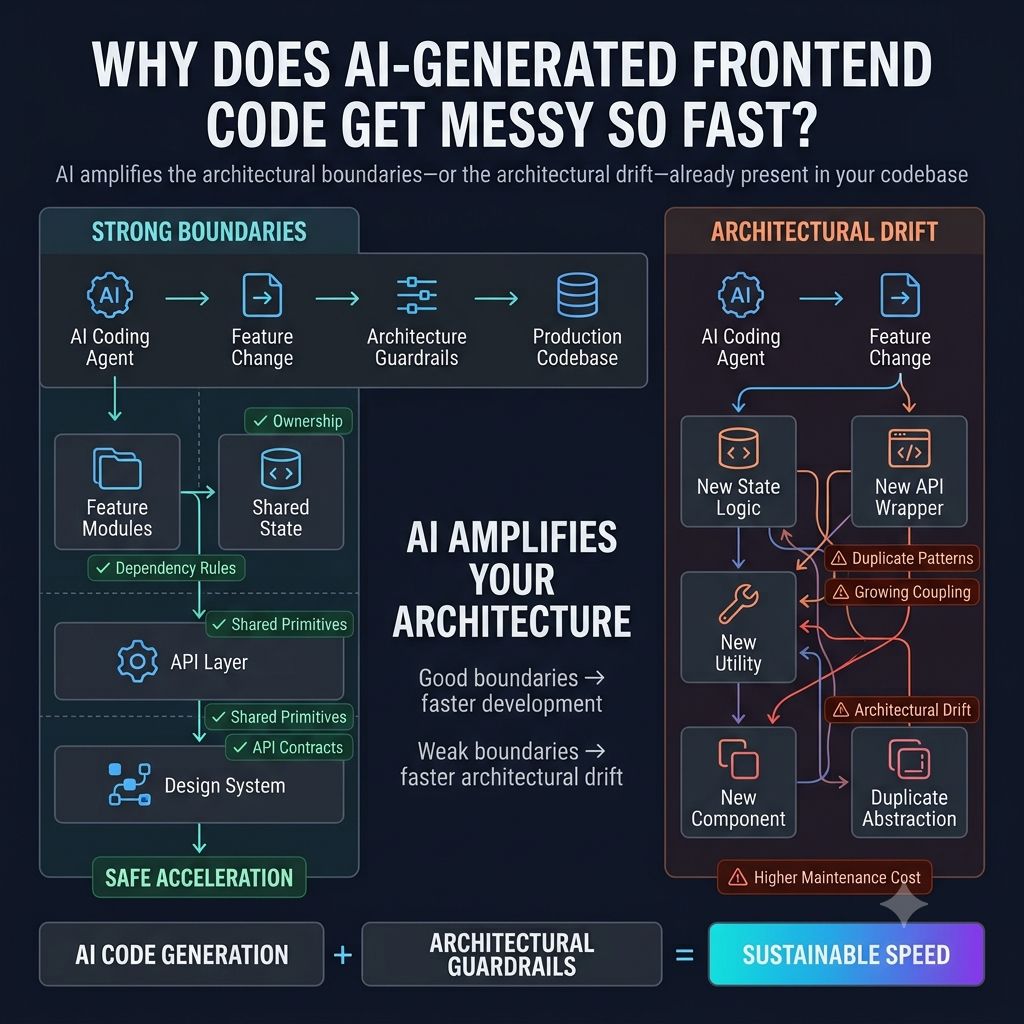
That's the dangerous part: AI doesn't necessarily create bad code, it can create too much locally reasonable code. At scale, frontend architecture needs constraints — clear module ownership, dependency boundaries, shared primitives, API contracts, design-system rules, state-management conventions, and automated architecture checks. The goal isn't to prevent AI from writing code; it's to make the wrong code harder to introduce.
That's the same distinction between AI-assisted and AI-governed development: the first optimizes for speed, the second for sustainable speed. The fastest team today isn't necessarily the one shipping the most code — it's the one that can still change the codebase quickly six months from now.
One principle worth keeping: Make the wrong code harder to introduce, not just the right code faster to write.
Would you measure AI productivity by lines of code shipped, or by how quickly the system can safely change?
Keep reading
Why a Fast Frontend Can Still Feel Slow
Rendering wasn't the bottleneck — waiting was. Why users experience waiting, not JavaScript execution, and the architectural decisions that reduce it.
Your Frontend Shouldn't Trust a Single Click
Disabling the button is not enough. Why duplicate-submission protection has to exist on the client and the server, and what each layer is responsible for.
Why Great UIs Don't Break When One API Fails
One failed request should not blank the page. Error boundaries, fallbacks and partial rendering that keep an interface usable when a service goes down.