Launching ResumeForge AI: ATS-Optimized Resumes in 60 Seconds
ResumeForge AI is live. Upload a resume, paste a job description, and get an ATS-optimized PDF in under a minute. Here is why I built it and how it works.
- Product Launch
- AI
- Resume
- ATS
- Career
- Side Project
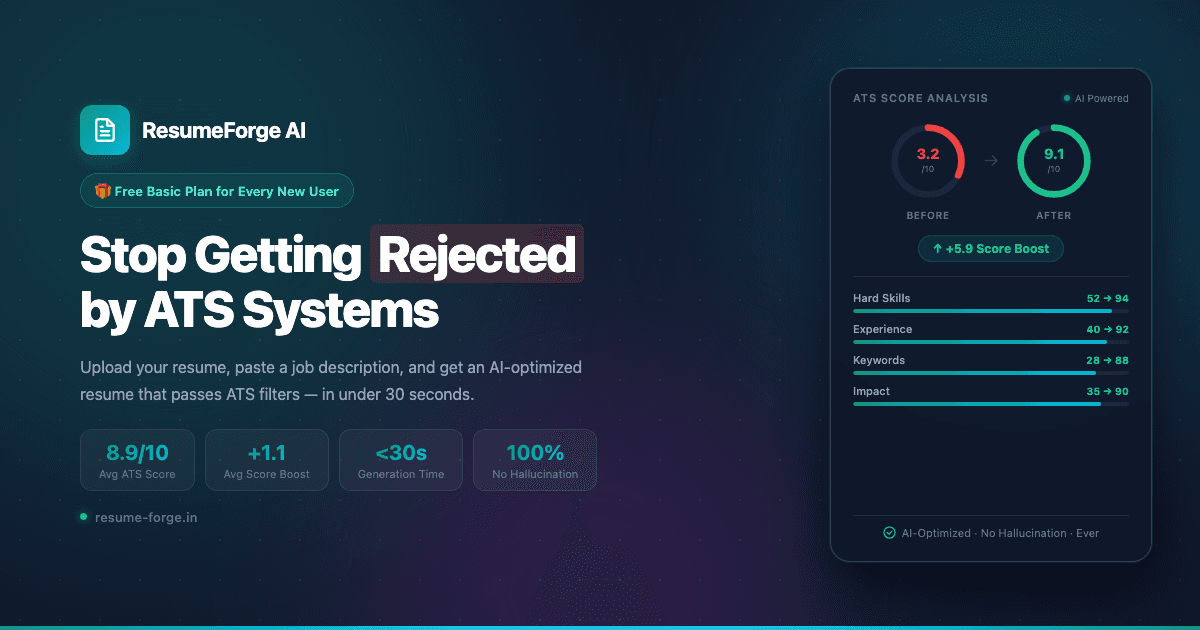
Today I shipped ResumeForge AI. Upload your resume, paste a job description, and walk away with an ATS-optimized PDF in under a minute. No subscriptions. No account required to try it. No fabricated skills.
This post covers the problem I kept seeing, the product I ended up building, and the design decisions behind it.
The Problem: You Are Not Unqualified, You Are Invisible
Around 75% of resumes never reach a human reviewer. An Applicant Tracking System (ATS) parses the file, scores it against the job description, and filters everything below a threshold. Recruiters read the short list that survives.
The candidates who get filtered out share the same patterns:
- Missing keywords from the job description
- Weak action verbs and no quantified impact
- Formatting that breaks parsers — multi-column layouts, images, tables, custom fonts
- Generic resumes reused across every role
The people getting rejected are not unqualified. They are invisible to the first gate. Fixing the gate is mostly mechanical — and that is what ResumeForge AI automates.
What ResumeForge AI Does
The flow is intentionally short:
- Drop your resume (PDF, DOCX, whatever you have)
- Paste the job description you are targeting
- AI scores your resume 0 to 10 across 10 dimensions
- Download an ATS-optimized PDF — rewritten section by section
You watch the optimization happen live. Each section streams in as it is rewritten, which is oddly satisfying to watch.
The 10 Scoring Dimensions
Instead of a single opaque "ATS score," every resume gets scored across ten specific dimensions: keyword coverage, action verb strength, quantified impact, formatting compliance, section structure, readability, relevance to the target role, redundancy, length, and overall tone. You see exactly where the gaps are before anything is rewritten.
What Makes It Different
Most "AI resume" tools are thin wrappers around a single ChatGPT call with a cute UI. That approach has two problems — hallucinations, and no real understanding of how ATS parsers work. I built around both.
Zero Hallucination by Design
The AI is constrained to work only with facts already present in your resume. It will not fabricate skills, tools, certifications, or experience you do not have. The job of the model is to restate, reorder, and reweight — not to invent. Your resume stays yours. Just optimized.
This was the single most important constraint. A resume that lies gets you past the ATS and then fails in the interview.
Hybrid Scoring: 70% Keyword Matching, 30% AI Analysis
Pure keyword matching is brittle — it rewards stuffing. Pure LLM scoring is non-deterministic and expensive. The scoring engine blends both:
- 70% deterministic keyword overlap against the JD (TF-IDF weighted, synonym-aware)
- 30% LLM-based semantic analysis for phrasing, impact, and role relevance
The weighting is tuned so that two resumes with similar keyword coverage can still be differentiated by how well they communicate impact. Pure keyword tools cannot do that.
Multi-Stage AI Pipeline
Generation is not a single prompt. The pipeline runs as a chain:
- Parse — extract structured sections from the uploaded file
- Analyze — score against the JD across 10 dimensions
- Plan — decide which sections need rewriting, in what order
- Rewrite — generate each section with grounding from the original
- Format — lay out a clean, ATS-parseable PDF
Each stage has a narrow job, which keeps outputs consistent and debuggable.
Speed: Under 30 to 60 Seconds End to End
From upload to downloadable PDF, the full pipeline runs in 30 to 60 seconds depending on resume length. I timed it across hundreds of runs during testing. Streaming the output section-by-section is what makes the wait feel instant.
Results From Testing
Across the resumes I tested during the beta, the average score improvement was 3.1 to 9.2 out of 10. The biggest lifts came from:
- Surfacing JD keywords the candidate already qualified for but had not mentioned
- Replacing responsibility-language ("worked on," "helped with") with impact-language ("shipped," "reduced," "owned")
- Tightening bullets from 3-4 lines down to 1-2 lines with a metric
- Fixing formatting that was silently breaking parsers
None of these changes required new information. The candidate already had the goods — the resume was just hiding them.
Pricing That Respects You
I did not want a subscription. Job searching is stressful enough without a recurring charge draining while you are between roles. Everything is pay-once credits that never expire.
| Tier | Price | Analyses | Generations |
|---|---|---|---|
| Basic | 15 | 7 | |
| Pro | ₹299 | 50 | 15 |
| Power | ₹699 | 150 | 40 |
The free tier is enough to fully test the product before paying. No card required. Credits carry forever — if you land a job today and look again in three years, your balance is still there.
Why I Built This
Every technical friend who has job-hunted in the last two years has had the same conversation with me: "I am applying to everything and hearing nothing." In most cases, their resumes were fine as documents — they just were not legible to the bot between them and the recruiter.
Fixing that gap is not glamorous work. It is mostly a parsing problem, a keyword problem, and a phrasing problem. But the people stuck behind it lose weeks of their lives to silence. That is what made it worth building.
Try It
resume-forge.in — free tier is live, no card, no signup wall to test.
If you know someone job hunting, forward them the link. Feedback, bug reports, and feature requests are very welcome — this is version one and the roadmap is shaped by what real users hit first.
Keep reading
Why Can't You Test an AI System Like a Normal API?
A normal API gives the same input the same output every time. Ask an AI system the same question twice and the answer can differ — or look completely correct and still be wrong.
How Does an AI Coding Agent Know What Code to Change?
"Add dark mode to this application" isn't prompt → LLM → code — a coding agent sits inside an orchestration loop of discovery, retrieval, planning, tool calls, tests, and feedback before anything ships.
Why Giving an AI Agent More Tools Can Make It Less Reliable
An agent with 50 tools sounds more capable than one with 5, but every extra tool is another way to fail — and another failure boundary the system has to bound, validate, and recover from.