How Does Google Return Results in Under a Second?
Google does not search the web when you hit enter — it searches an index built long before. How precomputation makes sub-second results possible.
- Real System Deep Dive
- Search
- Backend
- Frontend Architecture
- System Design
- Software Architecture
Every day, billions of searches are typed into Google. Yet the results often appear before you've even finished thinking about your query. That speed isn't magic. It's architecture.
When you search for something, Google isn't scanning the entire internet in real time. That would take far too long. Instead, a simplified request looks like this:
- 🔎 You enter a search query.
- 🌍 The request is routed to the nearest Google data center.
- ⚡ Search indexes are queried instead of crawling live websites.
- 📊 Multiple ranking signals evaluate relevance, freshness, authority, and hundreds of other factors.
- 📦 Frequently searched results are heavily optimized and cached.
- 📄 The highest-ranked results are returned in milliseconds.
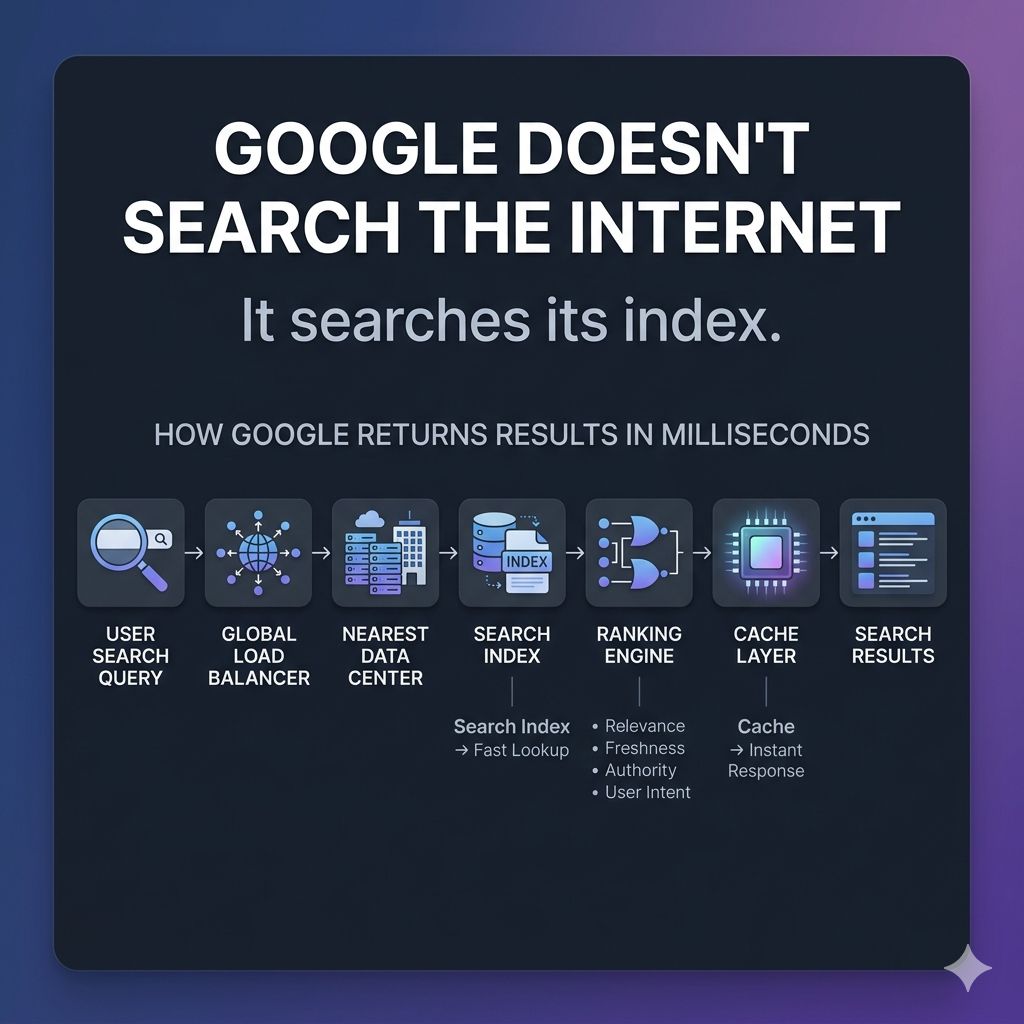
The interesting part isn't just speed. It's preparation.
Google spends enormous effort organizing and indexing information before you ever search for it.
That changes how I think about system design. Fast systems aren't built by doing everything quickly. They're built by doing the expensive work before users ask for it.
That's a pattern you'll see across almost every internet-scale system.
- Caching.
- Pre-computation.
- Indexing.
- Replication.
- Great architecture isn't just reactive.
- It's proactive.
Which large-scale system would you like me to break down next?
Keep reading
How Does Instagram Build Your Feed in Seconds?
Instagram does not build your feed when you open the app. How precomputation, fan-out and caching turn an expensive query into an instant scroll.
Every system works perfectly... until people start using it
Every system works until real users arrive. Where bottlenecks actually appear as load grows, and why the first one is almost never the code you suspected.
Why a Fast Frontend Can Still Feel Slow
Rendering wasn't the bottleneck — waiting was. Why users experience waiting, not JavaScript execution, and the architectural decisions that reduce it.