Why a Fast Frontend Can Still Feel Slow
Rendering wasn't the bottleneck — waiting was. Why users experience waiting, not JavaScript execution, and the architectural decisions that reduce it.
- Frontend at Scale
- Frontend Architecture
- Web Performance
- System Design
- Software Architecture
I've seen teams spend weeks improving frontend performance... Only to reduce page load time by a few milliseconds.
Meanwhile, users still complained that the application felt slow.
Why? Because rendering wasn't the bottleneck. Waiting was.
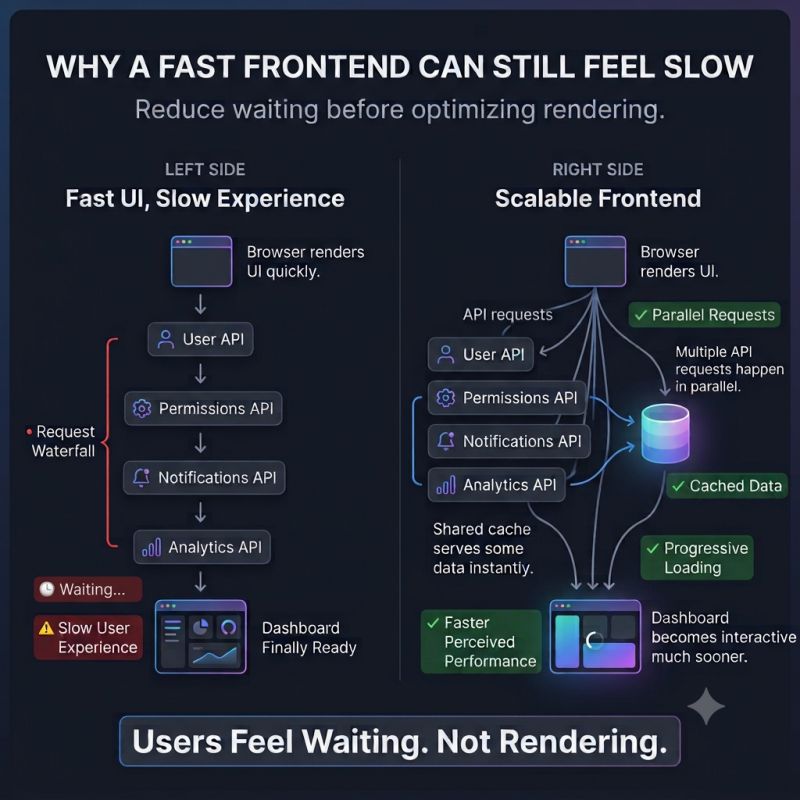
Think about what happens when a dashboard loads. The UI renders almost instantly.
Then it waits for:
- User profile
- Permissions
- Feature flags
- Notifications
- Analytics
- Recent activity
Your frontend isn't slow. It's waiting on five different services to respond.
That's why scaling frontend applications isn't just about rendering components faster. It's about reducing the time users spend waiting.
Some of the biggest improvements I've seen came from architectural decisions, not framework optimizations:
✓ Fetch independent data in parallel. ✓ Avoid request waterfalls. ✓ Batch related API calls. ✓ Cache data that's unlikely to change. ✓ Load only what's needed for the current screen.
One lesson that's changed how I approach frontend architecture: Users don't experience JavaScript execution. They experience waiting.
- Every unnecessary request...
- Every sequential API call...
- Every loading spinner...
Adds to that waiting time.
The best frontend applications aren't just fast at rendering. They're designed to spend less time waiting on the backend.
Where have you seen the biggest frontend performance improvement — better rendering or better data fetching?
Keep reading
Why Great UIs Don't Break When One API Fails
One failed request should not blank the page. Error boundaries, fallbacks and partial rendering that keep an interface usable when a service goes down.
Your UI Shouldn't Wait for Everything
Rendering nothing until every API responds makes a fast app feel slow. Progressive rendering, streaming and skeletons that show users something immediately.
Why Your Frontend Is Slow Even When React (or Angular) Is Fast?
Your framework is rarely the bottleneck. The real causes of slow UIs — request waterfalls, oversized bundles, and components that wait on the slowest API.