Every system works perfectly... until people start using it
Every system works until real users arrive. Where bottlenecks actually appear as load grows, and why the first one is almost never the code you suspected.
- System Design Fundamentals
- Backend
- Frontend Architecture
- System Design
- Software Architecture
One thing I've noticed over the years is that most systems don't fail because of bad code.
They fail because they were never expected to handle what came next. When an application has 10 users, almost any architecture looks good.
- At 1,000 users, you start seeing delays.
- At 10,000 users, bottlenecks become visible.
- At 100,000 users, those bottlenecks become everyone's problem.
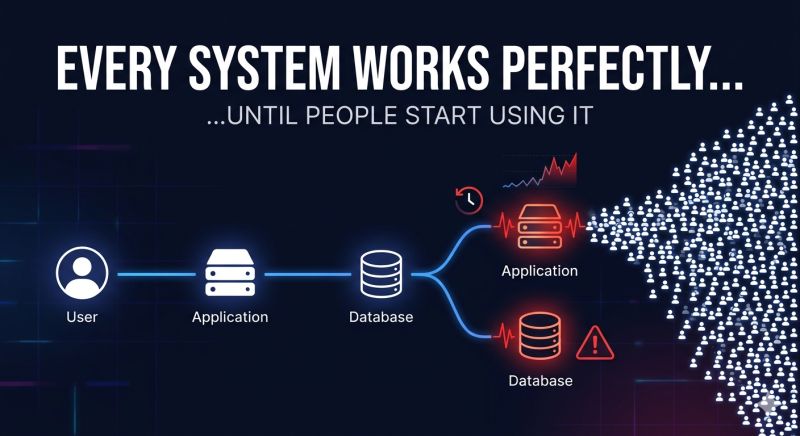
That's why I think the first lesson in System Design is surprisingly simple: Every system has a bottleneck.
The challenge isn't avoiding bottlenecks. The challenge is knowing where they're likely to appear. It could be:
- a database handling every request
- a single service doing too much work
- an API that wasn't built for the traffic it's receiving
The mistake many teams make is assuming they'll figure out scaling when growth arrives.
By the time growth arrives, you're often making architectural decisions under pressure.
The engineers I learn the most from don't obsess over designing for millions of users on Day 1.
They simply ask:If this system grows 10x, what breaks first?
That's usually where the real System Design conversation begins.
Question: What's the first bottleneck you've seen become a production issue?
Keep reading
How Does Google Return Results in Under a Second?
Google does not search the web when you hit enter — it searches an index built long before. How precomputation makes sub-second results possible.
How Does Instagram Build Your Feed in Seconds?
Instagram does not build your feed when you open the app. How precomputation, fan-out and caching turn an expensive query into an instant scroll.
Every Large-Scale System Is Sacrificing Something
The CAP theorem without the jargon. Every distributed system trades consistency, availability or partition tolerance — the skill is choosing deliberately.