How Does Instagram Build Your Feed in Seconds?
Instagram does not build your feed when you open the app. How precomputation, fan-out and caching turn an expensive query into an instant scroll.
- System Design Explained
- Backend
- Frontend Architecture
- System Design
- Software Architecture
When you open Instagram, your feed feels almost instant. But behind that one swipe is a surprisingly complex system. It isn't fetching every post from every person you follow in real time. That would be far too slow.
Instead, a typical request looks something like this:
- 📱 You open the app
- 🌍 A CDN serves static assets like images and JavaScript.
- 🚪 The request reaches an API Gateway, which authenticates the user and routes the request.
- ⚡ The Feed Service checks a cache first.
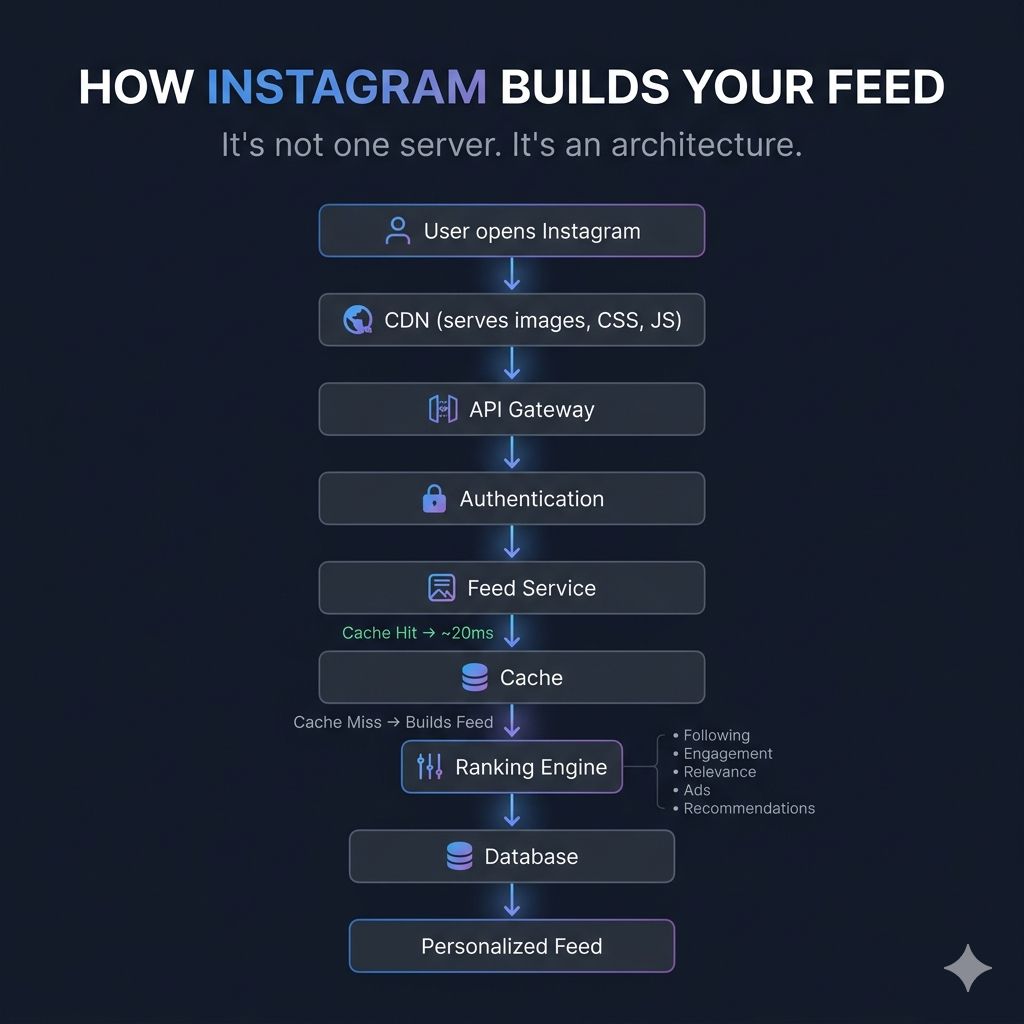
If your feed is already available, it can be returned in milliseconds.
If not, the service builds your feed by combining:
- Accounts you follow
- Recent activity
- Ranking signals
- Advertisements
- Recommended content
The final feed is cached before being returned to your device.
The result? A personalized feed delivered in well under a second.
One thing I find fascinating about systems like Instagram is this: The hardest part isn't storing the data.
It's deciding what to show you and how quickly it can be delivered.
That's why large-scale systems rely on multiple building blocks working together: ✔️ CDN ✔️ API Gateway ✔️ Cache ✔️ Databases ✔️ Ranking Services
No single technology makes Instagram fast. It's the architecture.
What's another real-world system you'd like to see broken down next?
Keep reading
Why Does One App Need Multiple Backends
The backend-for-frontend pattern explained: why a web client, a mobile app and a smart TV are better served by different backends than one shared API.
How Does Google Return Results in Under a Second?
Google does not search the web when you hit enter — it searches an index built long before. How precomputation makes sub-second results possible.
Every system works perfectly... until people start using it
Every system works until real users arrive. Where bottlenecks actually appear as load grows, and why the first one is almost never the code you suspected.