Why Your Frontend Is Slow Even When React (or Angular) Is Fast?
Your framework is rarely the bottleneck. The real causes of slow UIs — request waterfalls, oversized bundles, and components that wait on the slowest API.
- Frontend at Scale
- Frontend Architecture
- Web Performance
- Frontend
- React
- System Design
- Software Architecture
One of the biggest misconceptions I see is this: "If the UI feels slow, React (or Angular) must be the problem."
In reality, the framework is often the smallest part of the response time.
Think about what happens before your component renders:
- DNS lookup
- CDN serves static assets
- JavaScript bundles are downloaded
- API requests are sent
- Authentication happens
- Backend services process the request
- Database queries execute
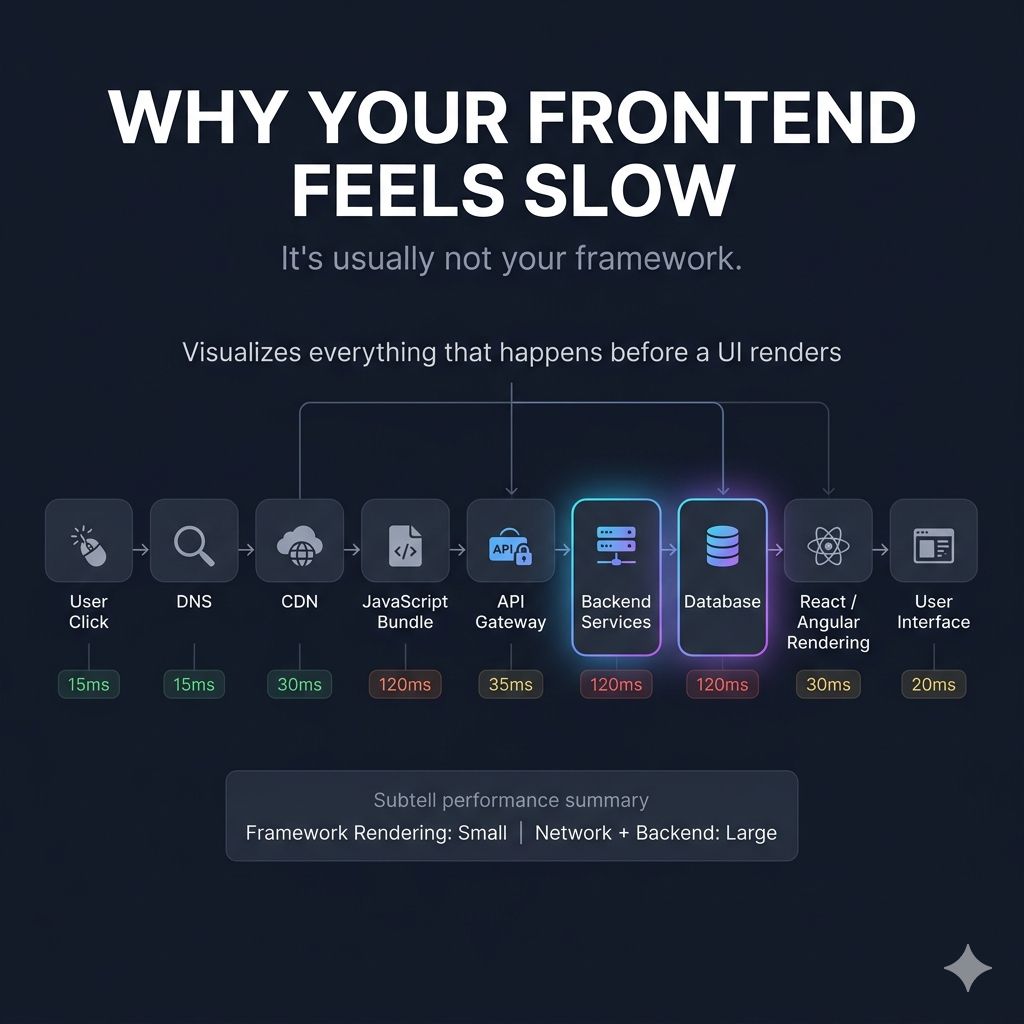
Only then does React or Angular render the UI.
If any one of those steps is slow, users don't care why. They just know the application feels slow.
That's why improving frontend performance isn't only about optimizing components. It's also about understanding the system behind them.
Questions I now ask before reaching for frontend optimizations:
- Are we making too many API calls?
- Can these requests run in parallel?
- Should this response be cached?
- Can static assets be served closer to users?
- Are we measuring where time is actually spent?
One lesson that changed how I approach performance:
The fastest frontend isn't always the one with the best code. It's the one backed by a well-designed architecture.
As frontend engineers, we don't just build interfaces anymore. We build experiences shaped by the entire system.
What has been the biggest performance bottleneck you've encountered in a frontend application?
Keep reading
Why Great UIs Don't Break When One API Fails
One failed request should not blank the page. Error boundaries, fallbacks and partial rendering that keep an interface usable when a service goes down.
Your UI Shouldn't Wait for Everything
Rendering nothing until every API responds makes a fast app feel slow. Progressive rendering, streaming and skeletons that show users something immediately.
Why Great Frontends Slowly Become Monoliths
Frontends rarely start as monoliths, they drift into them. The architectural decisions that let a codebase keep growing without seizing up.