Why the Biggest Production Mistake Is Trying to Say Yes to Every Request
Trying to process every request immediately is often what takes a system down, not the traffic itself. Why resilient systems reject, throttle, and shed load instead of pretending capacity is infinite.
- Production Lessons
- Scalability
- Site Reliability
- Distributed Systems
- Software Architecture
One production lesson changed how I think about system reliability. Healthy systems don't accept unlimited work.
At first, that sounds wrong. Isn't the goal to serve every request?
Not always.
Imagine your payment service suddenly receives ten times its normal traffic. If it tries to process every request immediately...
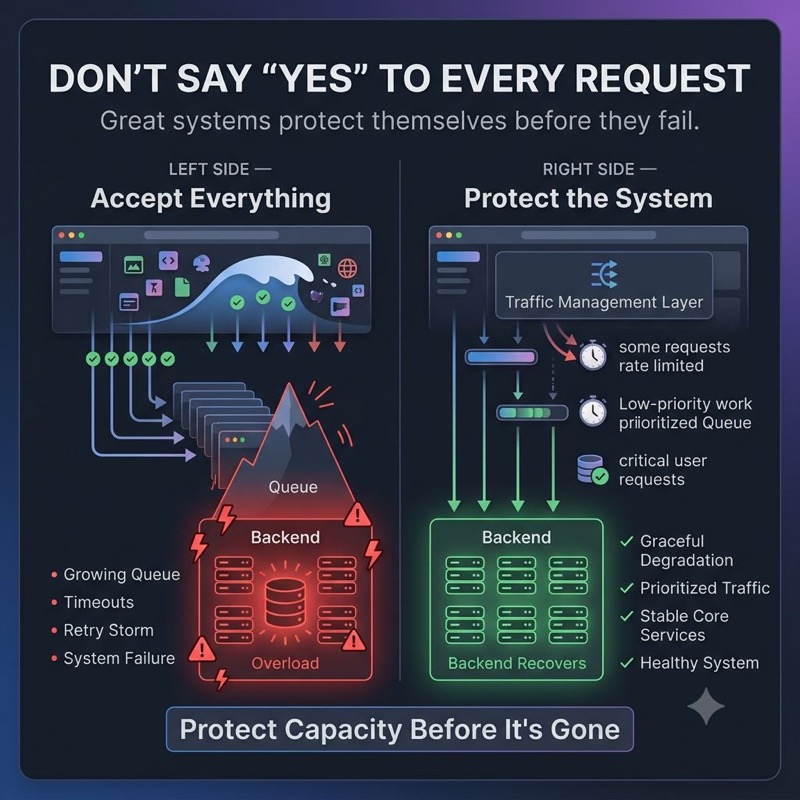
- Queues grow.
- Response times increase.
- Databases become overloaded.
- Timeouts start appearing.
- Retries create even more traffic.
Eventually... Everything slows down.
Sometimes the fastest way to take down a system is to make it accept work it can't realistically handle.
That's why resilient systems are designed with limits.
- They reject requests.
- They slow down clients.
- They prioritize critical operations.
- They shed non-essential traffic.
Not because they're failing... But because they're protecting the users who are already being served.
One lesson I've learned from production systems is this: Capacity isn't infinite. Pretending it is only delays the failure.
The best systems don't collapse all at once. They degrade gracefully.
- Maybe analytics stop updating.
- Maybe recommendations load later.
- Maybe background jobs wait.
But the core user journey stays available. That's not a compromise. That's good architecture.
Because in production, success isn't measured by how much work a system accepts. It's measured by how much useful work it continues to deliver when everything gets busy.
What's one production incident that changed the way you think about scalability or reliability?
Keep reading
Why Some Systems Crash at 1,000 Users While Others Handle Millions
A system doesn't become slow because more users arrive — it becomes slow because one component reaches its limit. Traffic exposes bottlenecks; it doesn't create them.
The Hardest Production Bug Is the One Your Telemetry Can't Explain
No error spike, no CPU alert, no obvious exception — just users saying something's wrong. Why the hardest incidents get solved by slicing the data, not staring at the average.
Why Adding Kafka Can Make Your System Worse
Kafka is powerful, but powerful doesn't mean necessary. Why reaching for an event bus before the problem demands one often trades a simple bug for a distributed system to operate.