Why Some Systems Crash at 1,000 Users While Others Handle Millions
A system doesn't become slow because more users arrive — it becomes slow because one component reaches its limit. Traffic exposes bottlenecks; it doesn't create them.
- Production Lessons
- Scalability
- Performance Engineering
- Distributed Systems
- Software Architecture
A system doesn't suddenly become slow because more users arrive. It becomes slow because one component reaches its limit.
That's an important difference.
I've seen teams prepare for growth by adding more application servers. The traffic increased. The server count doubled. But the application still struggled.
Why?
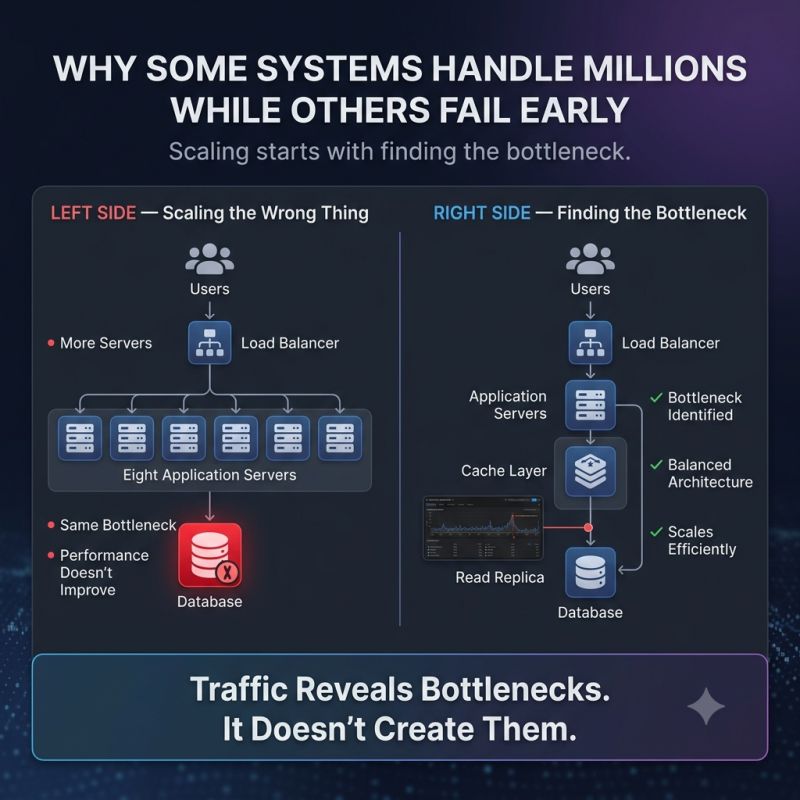
Because every request was waiting on the same database. Adding more servers didn't remove the bottleneck. It simply created more requests competing for the same resource.
Production systems almost always have a weakest link.
- Sometimes it's the database.
- Sometimes it's a cache.
- Sometimes it's a third-party API.
- Sometimes it's a message queue.
- Sometimes it's something as simple as a poorly indexed query.
The lesson isn't to scale everything. It's to identify what stops scaling first.
Before adding infrastructure, I always ask:
✓ Where is the request spending most of its time? ✓ Which dependency is saturated first? ✓ If traffic doubled tomorrow, what would fail first? ✓ Can this bottleneck be eliminated instead of scaled?
One principle has consistently held true across production systems: Traffic exposes bottlenecks. It doesn't create them.
Great architects don't start by asking, "How many more servers do we need?"
They start by asking, "What's preventing this system from scaling today?"
That single question often saves weeks of unnecessary engineering effort.
What's been the biggest bottleneck you've uncovered in production that wasn't obvious at first?
Keep reading
Why the Biggest Production Mistake Is Trying to Say Yes to Every Request
Trying to process every request immediately is often what takes a system down, not the traffic itself. Why resilient systems reject, throttle, and shed load instead of pretending capacity is infinite.
Why Adding Kafka Can Make Your System Worse
Kafka is powerful, but powerful doesn't mean necessary. Why reaching for an event bus before the problem demands one often trades a simple bug for a distributed system to operate.
Why More Servers Won't Always Fix Your Performance Problems
Doubling the server count and still slow — because the bottleneck was never the web servers. Why scaling means finding what can't scale, not adding capacity everywhere.