Why More Servers Won't Always Fix Your Performance Problems
Doubling the server count and still slow — because the bottleneck was never the web servers. Why scaling means finding what can't scale, not adding capacity everywhere.
- Architecture Breakdown
- Scalability
- Performance Engineering
- System Design
- Software Architecture
One of the most common reactions to a slow application is: "Let's add more servers."
Sometimes that works. Most of the time... It doesn't.
Here's why.
Imagine your application has five web servers. Traffic doubles. You increase it to ten.
But users still complain that the application feels slow.
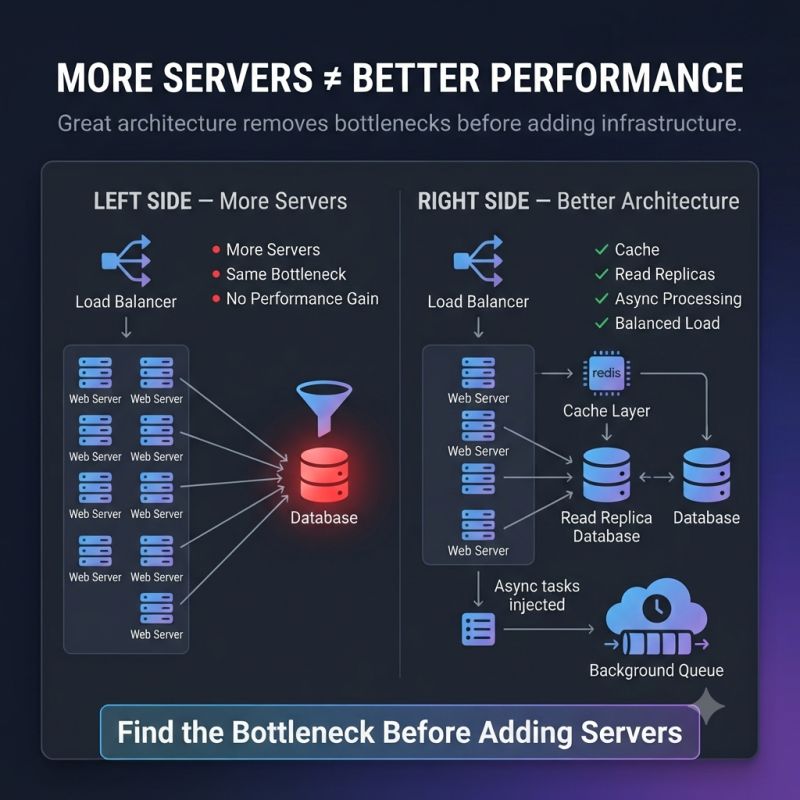
What happened? Because the bottleneck wasn't the web servers. It was somewhere else.
- Maybe every request still waits for the same database.
- Or every service calls the same third-party API.
- Or a single cache is overloaded.
- Or one message queue can't keep up.
Adding more application servers simply means more systems waiting for the same bottleneck.
That's one of the biggest lessons I've learned from production systems: Scaling isn't about adding capacity everywhere. It's about finding what can't scale.
Before adding infrastructure, ask a few simple questions:
✓ What's the slowest part of this request? ✓ Which component is under the highest load? ✓ Can this work be cached? ✓ Can it be processed asynchronously? ✓ Is this service truly stateless?
Architecture is rarely limited by the number of servers. It's usually limited by the weakest dependency in the request path.
One principle I always come back to is this: You don't scale a system by adding more servers. You scale it by removing bottlenecks.
What's the biggest bottleneck you've encountered in a production system — database, cache, third-party API, or something unexpected?
Keep reading
Why Great Systems Don't Query the Database Every Time
The database wasn't overloaded — the application was asking the same question thousands of times. How caching lets systems scale by making databases work less.
Why Are We Using Chat Models to Make Decisions?
Classify something, route something, score a risk — for years the answer has been "ask the LLM," then parse and validate the text it hands back. That mismatch gets expensive in production.
Why AI Can Write Code Faster but Make Architecture More Important
A feature that once took a day can now ship in minutes, which sounds like architecture matters less. The opposite is true — when code gets cheaper to produce, bad architecture gets cheaper to produce too.