Why "Perfect" Data Isn't Always the Right Goal
Waiting for every replica to agree before responding isn't always the right trade. How production systems choose a consistency level per use case instead of chasing perfection everywhere.
- Production Lessons
- Eventual Consistency
- Distributed Systems
- Database Architecture
- System Design
One production lesson surprised me more than almost anything else. Sometimes the right answer isn't the latest answer.
At first, that sounds wrong. Shouldn't every user always see the most up-to-date data?
In an ideal world, yes. In large-scale systems, not always.
Imagine a global application with users across multiple regions.
- Every profile update.
- Every inventory change.
- Every notification.
Each one needs to travel across servers, databases, and data centers.
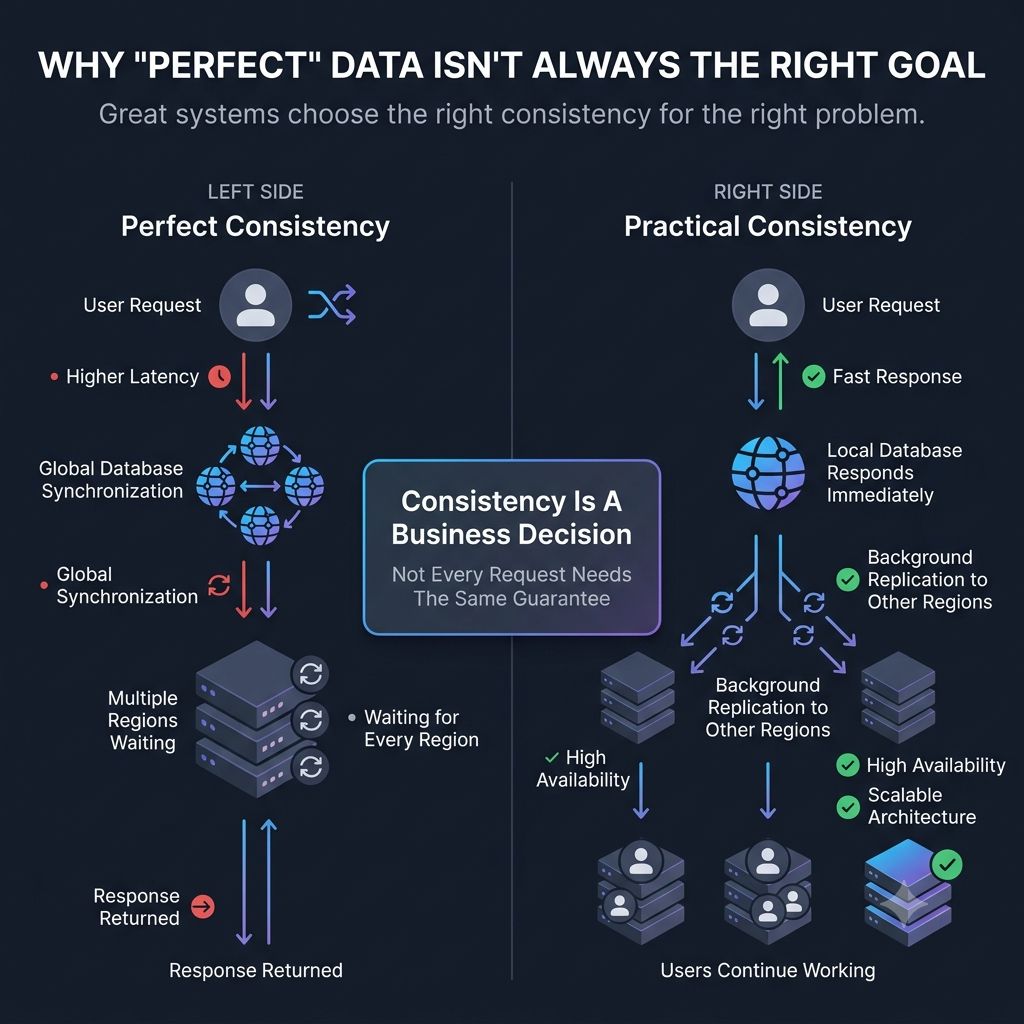
If every request waited until every copy of the data was perfectly synchronized:
- Users would wait longer.
- Latency would increase.
- Availability would suffer.
That's why many production systems make a deliberate trade-off. They accept that, for a brief moment, different users might see slightly different versions of the same data — not because the system is broken, but because it's designed to stay fast, available, and resilient.
The important question isn't "is the data perfectly up to date?" It's: "Is it fresh enough for this user and this action?"
Viewing a product description? A few seconds of delay may be acceptable. Confirming a payment? Accuracy matters far more than speed.
One lesson that's stayed with me throughout my career: Not every piece of data deserves the same consistency guarantees.
Great architectures don't chase perfection everywhere. They choose the right level of consistency for the problem they're solving.
That's often the difference between a system that scales and one that struggles under its own expectations.
Where have you seen teams intentionally choose availability or speed over immediate consistency?
Keep reading
Why Your UI Sometimes Shows "Old" Data on Purpose
A brief flash of stale data after a refresh isn't always a bug — it's often eventual consistency at work. Why modern frontends favor a responsive UI with a background refresh over waiting for perfect freshness.
How Does Netflix Know Something Is Broken Before You Do?
Thousands of services sit behind a single "Press Play" — how Netflix connects metrics, logs, traces, and client telemetry to catch playback failures before users report them.
The Hardest Production Bug Is the One Your Telemetry Can't Explain
No error spike, no CPU alert, no obvious exception — just users saying something's wrong. Why the hardest incidents get solved by slicing the data, not staring at the average.