Why Modern Applications Need an API Gateway
What an API gateway actually does — routing, authentication, rate limiting and aggregation — and why microservice architectures struggle without one.
- Architecture Breakdown
- API Gateway
- Microservices
- Software Architecture
- System Design
At first glance, an API Gateway looks simple. A request comes in. The gateway forwards it to the right service. Done.
But that's only a small part of its job. Imagine your frontend talking directly to 15 different microservices.
Every client would need to know:
- Which service to call
- How to authenticate
- Which API version to use
- How to handle failures
- How to retry requests
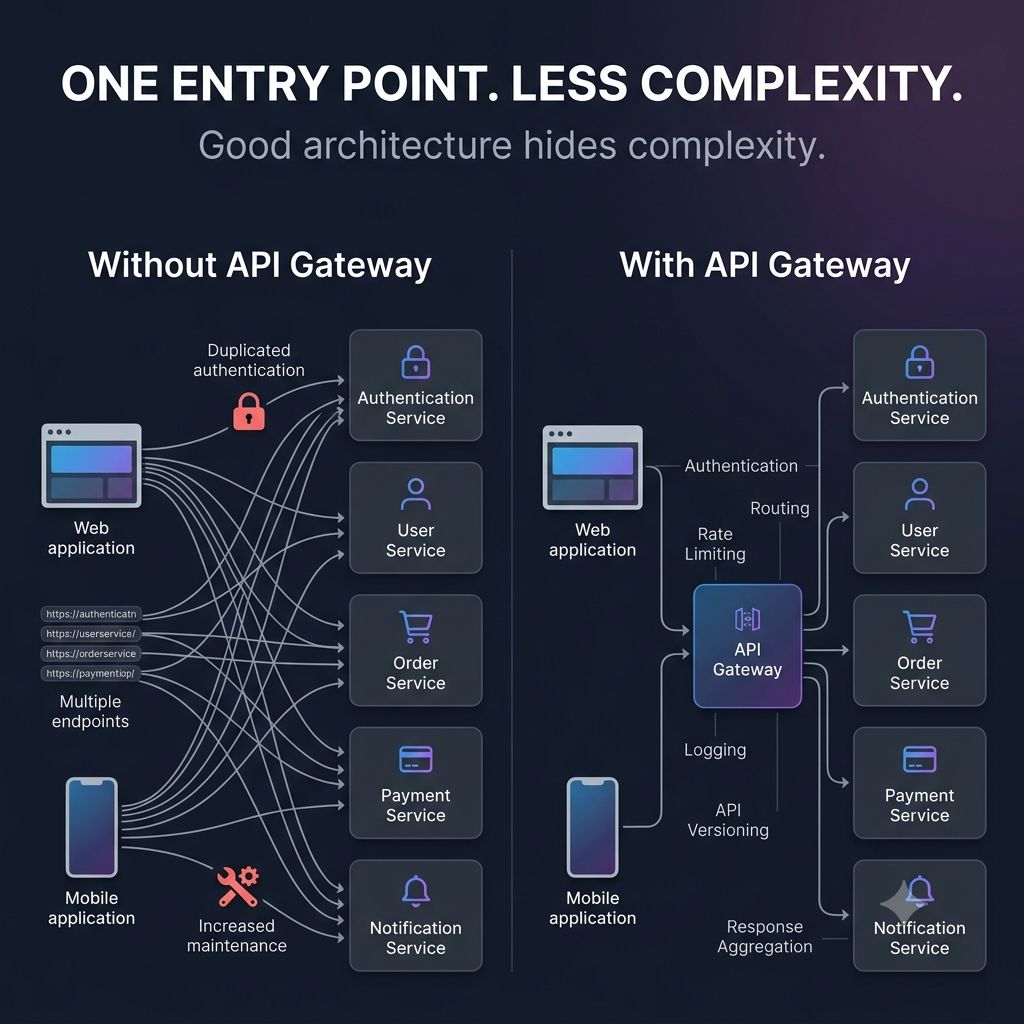
That complexity quickly spreads across every application consuming those APIs. An API Gateway changes that.
It becomes the single entry point into your system. Instead of every client talking to every service, they talk to one gateway.
Behind the scenes, the gateway can: ✓ Authenticate requests ✓ Route traffic to the correct service ✓ Aggregate responses ✓ Apply rate limiting ✓ Log requests ✓ Handle API versioning
One thing I appreciate about good architecture is this: It reduces complexity for everyone else.
An API Gateway isn't just another service. It's a boundary. It hides the complexity of your backend so your clients don't have to carry it. As systems grow, that's often more valuable than any performance optimization.
Keep reading
Why Your Dashboard Can Say "Healthy" While Your Users Can't Use the Product
CPU normal, memory normal, error rate 0.2% — and support says users can't check out. Why infrastructure health and user experience are measured by different questions.
Why Great Systems Don't Make You Wait for Everything
Order confirmation shouldn't wait on payment, inventory, email, and analytics to all finish. How separating the critical path from everything else keeps event-driven systems responsive.
Why Great Systems Say "No" More Often Than You Think
A system doesn't fail because it rejects requests — it fails because it accepts too many. Why rate limiting and the 429 status code protect the experience for everyone.