Why Great Systems Don't Make You Wait for Everything
Order confirmation shouldn't wait on payment, inventory, email, and analytics to all finish. How separating the critical path from everything else keeps event-driven systems responsive.
- Architecture Breakdown
- Event-Driven Architecture
- Distributed Systems
- Software Architecture
- System Design
You click "Place Order."
The system could wait for:
- Payment confirmation.
- Inventory update.
- Email notification.
- Analytics.
- Recommendation updates.
- Loyalty points.
- Shipping workflow.
- Fraud checks.
...and only then return: "Order successful."
But that's a terrible user experience. And at scale, it's a terrible architecture.
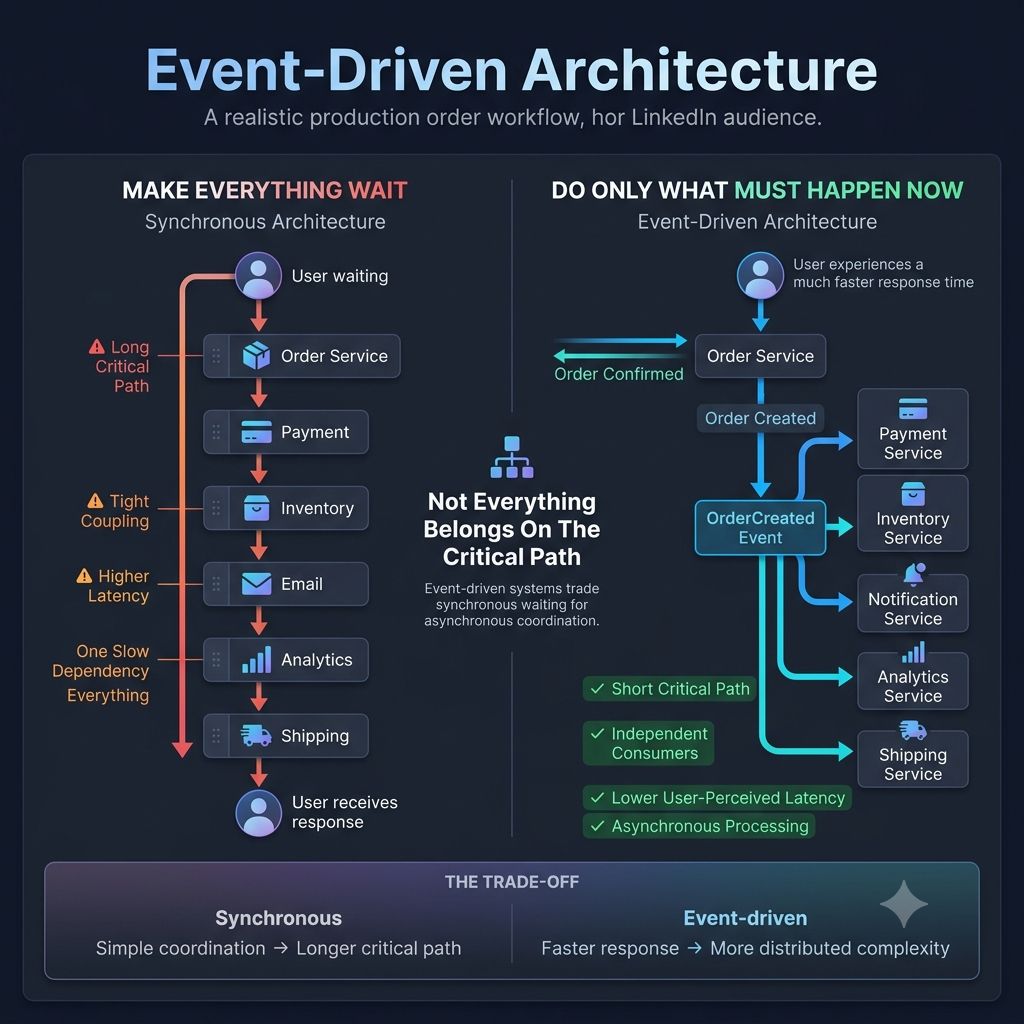
The better approach separates what must happen now from what can happen afterward.
A simplified flow looks like this:
- 🛒 User places an order.
- ⚡ Order Service validates and creates the order.
- ✅ User gets a response.
- 📢 An
OrderCreatedevent is published. - 🔀 Multiple services react independently — Inventory, Notifications, Analytics, Recommendations, Shipping.
The order service doesn't need to know how every downstream system works. It simply publishes that something happened, and other services decide what to do about it. That's the fundamental idea behind event-driven architecture.
One event can trigger many independent workflows without making the original request wait for all of them.
But there's a trade-off. Now you're dealing with:
- Eventual consistency.
- Duplicate events.
- Failed consumers.
- Event ordering.
- Retries and replay.
So event-driven architecture isn't automatically "better." It moves complexity from synchronous coordination into asynchronous coordination — the part many architecture diagrams don't show.
One lesson I've learned from designing systems at scale: Don't make the user wait for work that doesn't need to block them. Keep the critical path small. Move everything else behind it.
The goal isn't to make every operation asynchronous. It's to make a deliberate decision about what deserves to be on the critical path.
Where have you seen unnecessary synchronous work make an application slower than it needed to be?
Keep reading
Why Your Dashboard Can Say "Healthy" While Your Users Can't Use the Product
CPU normal, memory normal, error rate 0.2% — and support says users can't check out. Why infrastructure health and user experience are measured by different questions.
Why Some Requests Shouldn't Wait
Not every request needs an immediate answer. How message queues move slow work off the critical path and keep an application responsive under load.
How Does Uber Know Your Driver Moved Without You Refreshing the App?
A driver moves 200 meters and your screen updates without a refresh — the event pipeline, ordering problems, and filtering decisions behind Uber's live location tracking.