Why Great Systems Don't Give Up After One Failure
Retries, exponential backoff and circuit breakers — how resilient systems recover from transient failures without amplifying them into an outage.
- Architecture Breakdown
- Reliability
- Software Architecture
- System Design
(Retries Explained)
You're checking out on an online store. You click Pay. For a moment... Nothing happens. A second later, the payment succeeds.
What changed? In many cases, nothing. The first request simply failed because of a temporary issue.
- A brief network interruption.
- A busy service.
- A timeout.
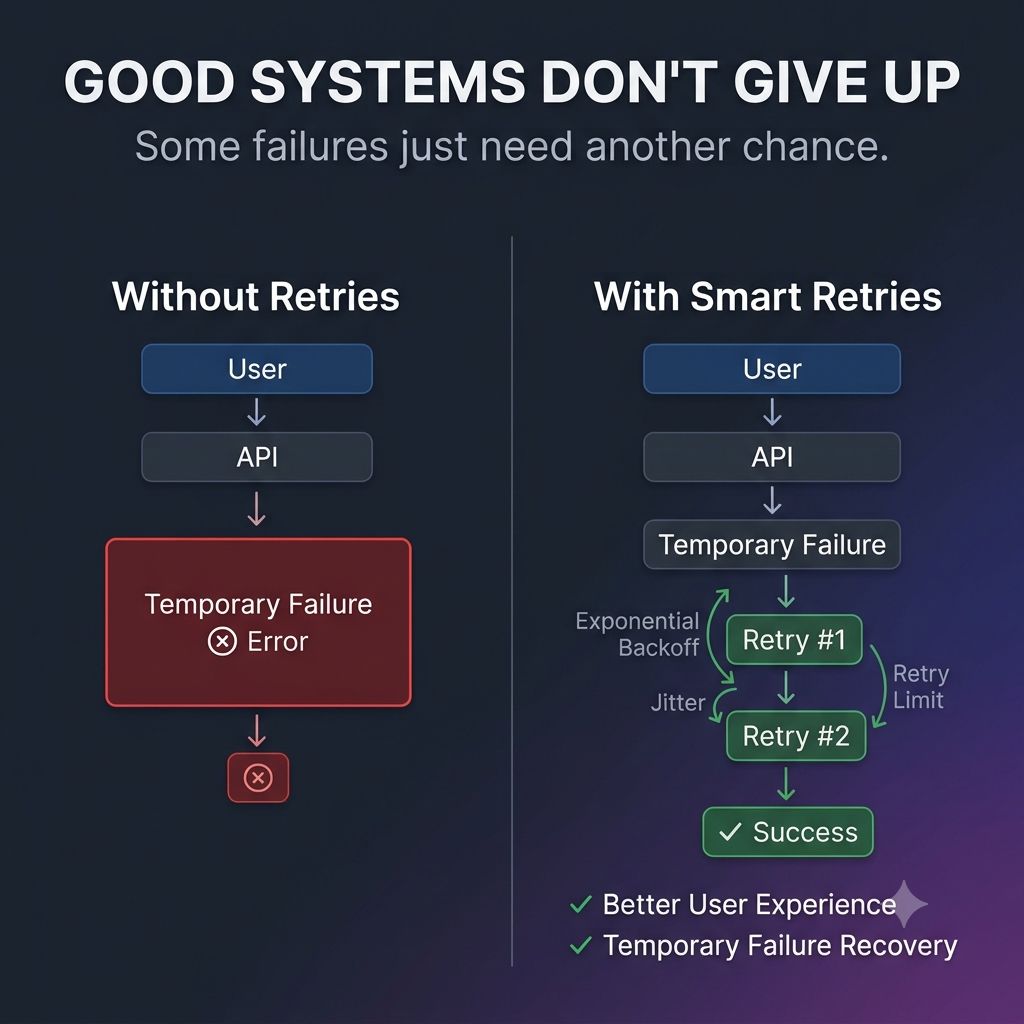
Instead of immediately showing an error, many systems automatically retry the request.
Not because failures are acceptable. Because temporary failures are expected. That's an important shift in mindset.
In distributed systems, not every failure is permanent. Some disappear a moment later. Retries give systems a chance to recover without involving the user. But there's a trade-off.
- Retry too aggressively and you can make a struggling service even worse.
- Retry too little and users see failures that could have recovered automatically.
That's why resilient systems combine retries with: ✓ Timeouts ✓ Exponential backoff ✓ Jitter to avoid retry storms ✓ Sensible retry limits
One lesson that's influenced how I think about architecture: A failed request isn't always the end of the story.
Sometimes it's simply the beginning of a recovery strategy. The goal isn't to eliminate failures. It's to make sure users experience as few of them as possible.
Keep reading
Why One Click Shouldn't Create Two Orders
Users double-click, browsers retry and networks reconnect. How idempotency keys stop one intent from becoming two orders.
Why Your Dashboard Can Say "Healthy" While Your Users Can't Use the Product
CPU normal, memory normal, error rate 0.2% — and support says users can't check out. Why infrastructure health and user experience are measured by different questions.
Why Great Systems Don't Make You Wait for Everything
Order confirmation shouldn't wait on payment, inventory, email, and analytics to all finish. How separating the critical path from everything else keeps event-driven systems responsive.