Why Every Fast Website Starts With a CDN?
How a CDN cuts latency by serving content from the edge, what belongs on it, and why nearly every fast site on the internet starts with one.
- Architecture Breakdown
- CDN
- Web Performance
- Frontend Architecture
- Software Architecture
- System Design
Most engineers think a fast website starts with better code.
- Cleaner components.
- Faster APIs.
- Optimized database queries.
Those all help. But one of the biggest performance improvements often happens before your server receives a single request. That's where a CDN comes in.
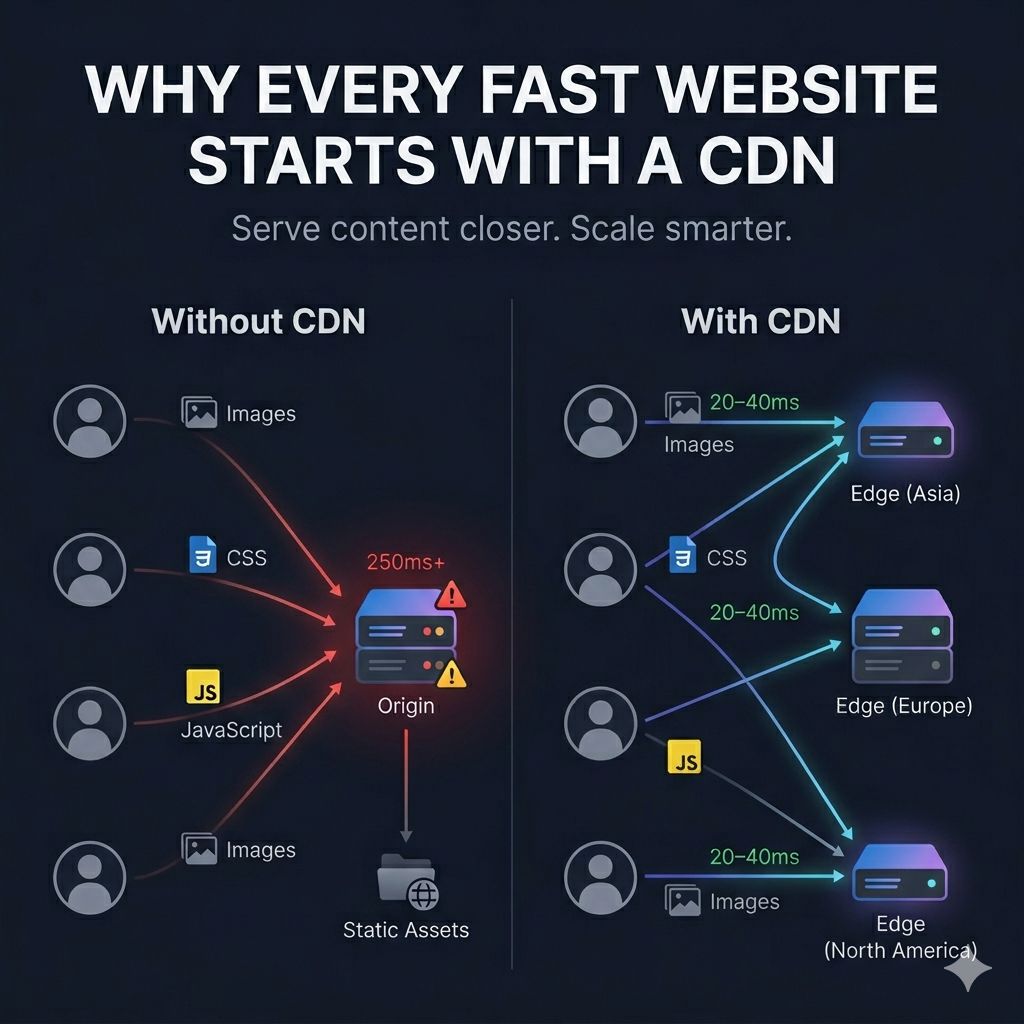
A CDN (Content Delivery Network) stores copies of your static assets—images, JavaScript, CSS, videos—across multiple locations around the world.
Instead of every user requesting those files from a single server, they're served from the nearest edge location.
The result?
- Less distance.
- Lower latency.
- Faster load times.
But here's something I didn't fully appreciate early in my career: A CDN isn't just about speed. It's about reducing unnecessary work.
Every request served by the CDN is one less request your application has to process.
Which means your servers can focus on what actually requires business logic. That's one reason companies like Netflix, Amazon, GitHub, and Vercel rely heavily on CDNs.
As traffic grows, serving everything from your origin server simply doesn't scale.
One lesson that's stayed with me: Good architecture isn't just about making systems faster.
It's about making sure your application does less work in the first place.
This is the first post in my new Architecture Breakdown series, where I'll simplify one production architecture concept every week.
Next up: Why API Gateways are more than just request routers.
Keep reading
Why a Fast Frontend Can Still Feel Slow
Rendering wasn't the bottleneck — waiting was. Why users experience waiting, not JavaScript execution, and the architectural decisions that reduce it.
Why Great UIs Don't Break When One API Fails
One failed request should not blank the page. Error boundaries, fallbacks and partial rendering that keep an interface usable when a service goes down.
Your UI Shouldn't Wait for Everything
Rendering nothing until every API responds makes a fast app feel slow. Progressive rendering, streaming and skeletons that show users something immediately.