Why Doesn't Instagram Crash When Millions of People Open It at the Same Time?
It's not one incredibly powerful server — it's thousands of systems sharing the work. How load balancing, caching, and horizontal scaling keep Instagram responsive.
- System Design Explained
- Load Balancing
- Horizontal Scaling
- Distributed Systems
- System Design
Imagine millions of people opening Instagram within the same few minutes.
- Checking stories.
- Refreshing their feed.
- Uploading photos.
- Watching reels.
- Sending messages.
Yet... for most users, the app still feels responsive.
So what's the secret? It's not one incredibly powerful server. It's thousands of systems sharing the work.
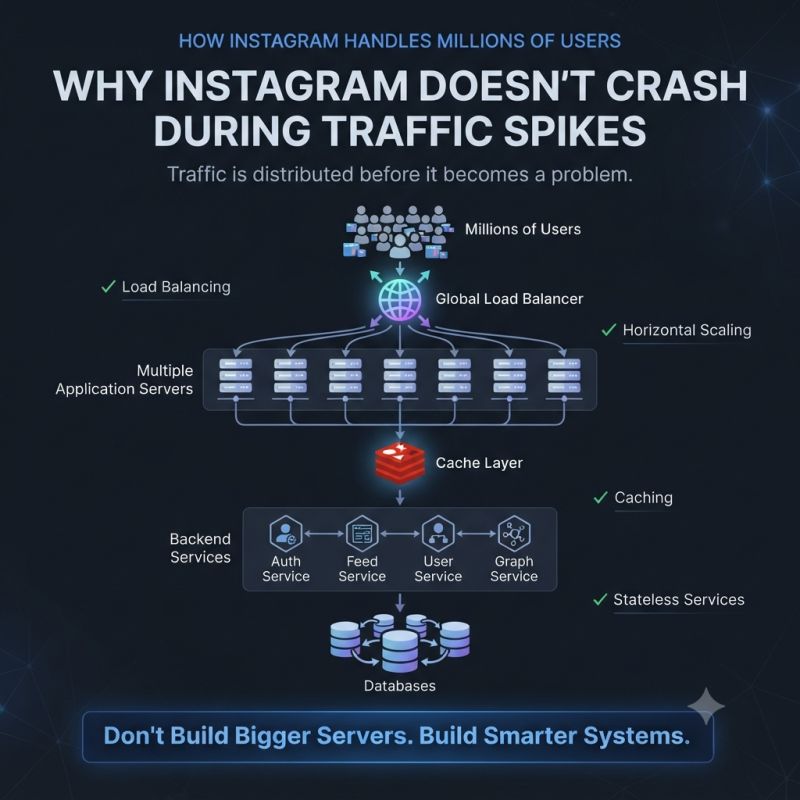
A simplified request journey looks like this:
- 📱 You open Instagram.
- 🌍 Your request first reaches a load balancer.
- ⚖️ Instead of sending everyone to one server, traffic is distributed across many application servers.
- ⚡ Frequently accessed content is served from caches whenever possible.
- 📦 Only requests that truly need fresh data reach backend services and databases.
As traffic grows... Instagram doesn't rely on a single machine getting bigger. It adds more instances, distributes traffic, and removes bottlenecks.
That's horizontal scaling in action.
One thing I've learned from studying large-scale systems: Scaling isn't about building one powerful server. It's about making sure no single server has to do all the work.
Every component has a limit. The job of architecture is to make sure no single component becomes everyone's problem.
The next time an application feels fast during a major event or product launch, there's a good chance you're seeing load balancing, caching, and horizontal scaling working together behind the scenes.
Which large-scale system would you like me to break down next?
Keep reading
Why Does One Slow Service Make Your Whole App Feel Slow?
An API that "responds in 1.8 seconds" is rarely slow on its own — distributed tracing breaks a request into spans to show which dependency actually spent the time.
Why Doesn't Your Order Confirmation Wait for Everything to Finish?
Payment, inventory, fraud checks, shipping, notifications — a single "Order Confirmed" doesn't wait for all of them. How publish-subscribe events let one action fan out into independent workflows.
What If Your AI Didn't Need to Generate Text?
The usual AI pipeline — prompt in, text out — breaks down the moment your application needs a decision instead of a paragraph. A typed-question approach can replace an entire generation-and-parsing pipeline.