Why Doesn't an AI Agent Just Change Your Code?
An AI coding agent can find a bug, fix it, and pass its tests in minutes — but "tests passed" doesn't mean "the change is correct," which is exactly why production agents need a controlled loop, not direct write access.
- Real System Deep Dive
- AI Agents
- Agentic AI
- AI Architecture
- System Design
Ask an AI coding agent to fix an authentication bug, and it will find the code, change it, run the tests, and look done. But would you let it push directly to production? Probably not — generating code is only one part of the problem.
A production coding agent needs a controlled loop: understand, plan, act, test, evaluate, approve, deploy. Everything around the model is what makes it safe. Context comes first — the right repository files, architecture patterns, dependencies, and tests. Tools come next, and they need boundaries: the agent might search code, edit files, run tests, and open a pull request, but it shouldn't automatically have permission to delete production data or deploy anything it wants.
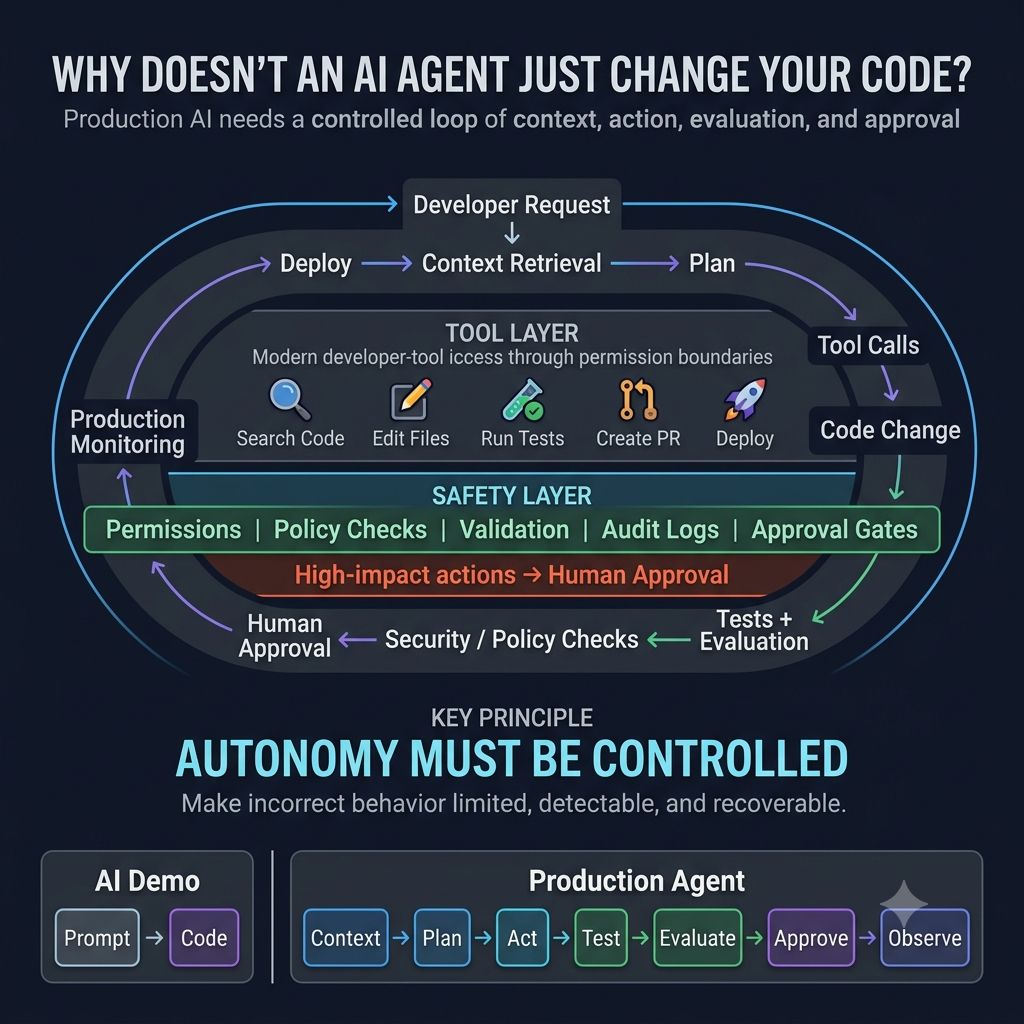
Then comes evaluation, and this is where it gets subtle: "tests passed" doesn't always mean "the change is correct" — an agent can pass every existing test while introducing a regression nobody covered. That's why production systems layer on automated tests, static analysis, security checks, policy validation, review gates, and human approval for high-impact actions, and keep observing the result after deployment, because the system can make a decision you didn't explicitly program.
Reliability can't depend entirely on the model behaving correctly — the architecture needs to make incorrect behavior limited, detectable, and recoverable. The better question isn't "how autonomous can we make it?" It's "how much autonomy can we safely control?"
One principle worth keeping: Reliability isn't about trusting the model — it's about making incorrect behavior limited, detectable, and recoverable.
Would you allow an AI coding agent to merge directly into production if every automated check passed?
Keep reading
What If Your AI Didn't Need to Generate Text?
The usual AI pipeline — prompt in, text out — breaks down the moment your application needs a decision instead of a paragraph. A typed-question approach can replace an entire generation-and-parsing pipeline.
Why Are We Using Chat Models to Make Decisions?
Classify something, route something, score a risk — for years the answer has been "ask the LLM," then parse and validate the text it hands back. That mismatch gets expensive in production.
How Does an AI Coding Agent Change a Massive Codebase Without Breaking Everything?
Changing one file is easy; changing a massive codebase safely is a completely different problem. The biggest risk isn't obviously bad code — it's reasonable code landing in the wrong place, hundreds of times over.