The Network Is Not Reliable. Design Like It
Networks drop packets, time out and partition. Designing for those realities instead of hoping otherwise separates reliable systems from fragile ones.
- System Design Fundamentals
- Reliability
- System Design
- Software Architecture
When engineers first design a system, there's usually one assumption hiding in the background:
- Everything will work.
- The database will respond.
- The API will be available.
- The network will be stable.
- The downstream service will return data. Until one day it doesn't.
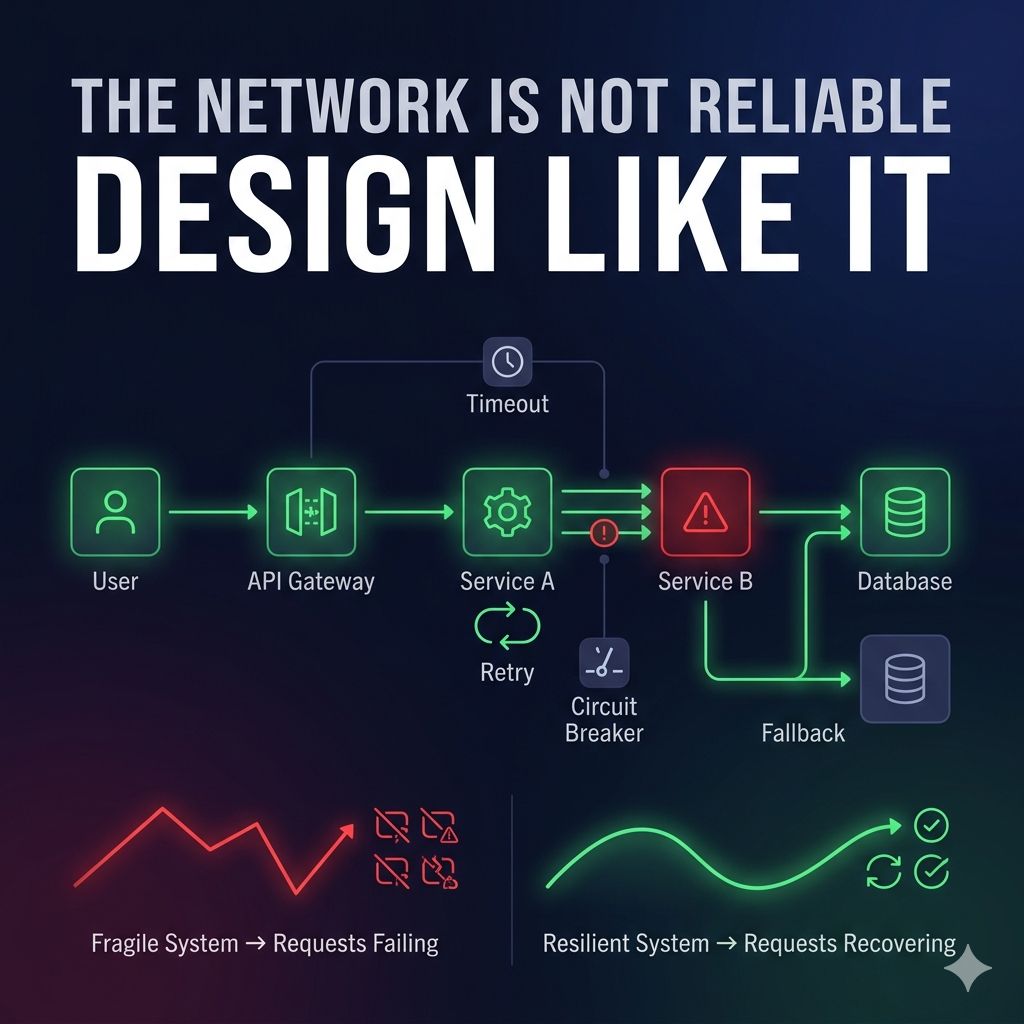
And that's when system design becomes real. Over the years, I've noticed that most production incidents aren't caused by complex algorithms or obscure bugs. They're caused by assumptions.
- Assumptions that a dependency would always be available.
- Assumptions that a request would always succeed.
- Assumptions that a timeout would never happen.
In distributed systems, failures aren't edge cases. They're expected behavior. That's why resilient systems use patterns like:
- Timeouts
- Retries
- Circuit breakers
- Fallbacks
Not because failure is likely. Because failure is inevitable.
One idea changed how I think about architecture: A good system isn't one that never fails. It's one that fails gracefully.
Users may never notice a successful request. But they'll always remember an unavailable system. And that's why reliability is ultimately a design decision.
If you've followed this series, you've already learned more system design than most engineers realize.
Question: What's the biggest lesson you've learned from a production failure?
Keep reading
Why One Click Shouldn't Create Two Orders
Users double-click, browsers retry and networks reconnect. How idempotency keys stop one intent from becoming two orders.
How Does Zoom Keep Your Meeting Alive When Your Network Is Bad?
Adaptive bitrate, audio priority and automatic reconnection — how Zoom optimizes for keeping the conversation alive rather than for perfect video.
The Biggest Architectural Mistake? Optimizing for the Happy Path
Most architectures are designed for everything going right. Why the failure paths deserve as much design attention as the success path.