The Best Systems Aren't The Ones That Never Fail
Reliability is not the absence of failure, it is graceful behaviour during one. Designing systems that degrade instead of collapsing.
- Production Lessons
- Reliability
- Software Architecture
- System Design
One assumption quietly slips into a lot of software projects: "If everything works, we're good."
But production systems don't live in perfect conditions.
- Networks timeout.
- Dependencies become unavailable.
- Databases get slower.
- Third-party APIs fail.
- Traffic spikes unexpectedly.
The question isn't whether something will fail. It's what happens next.
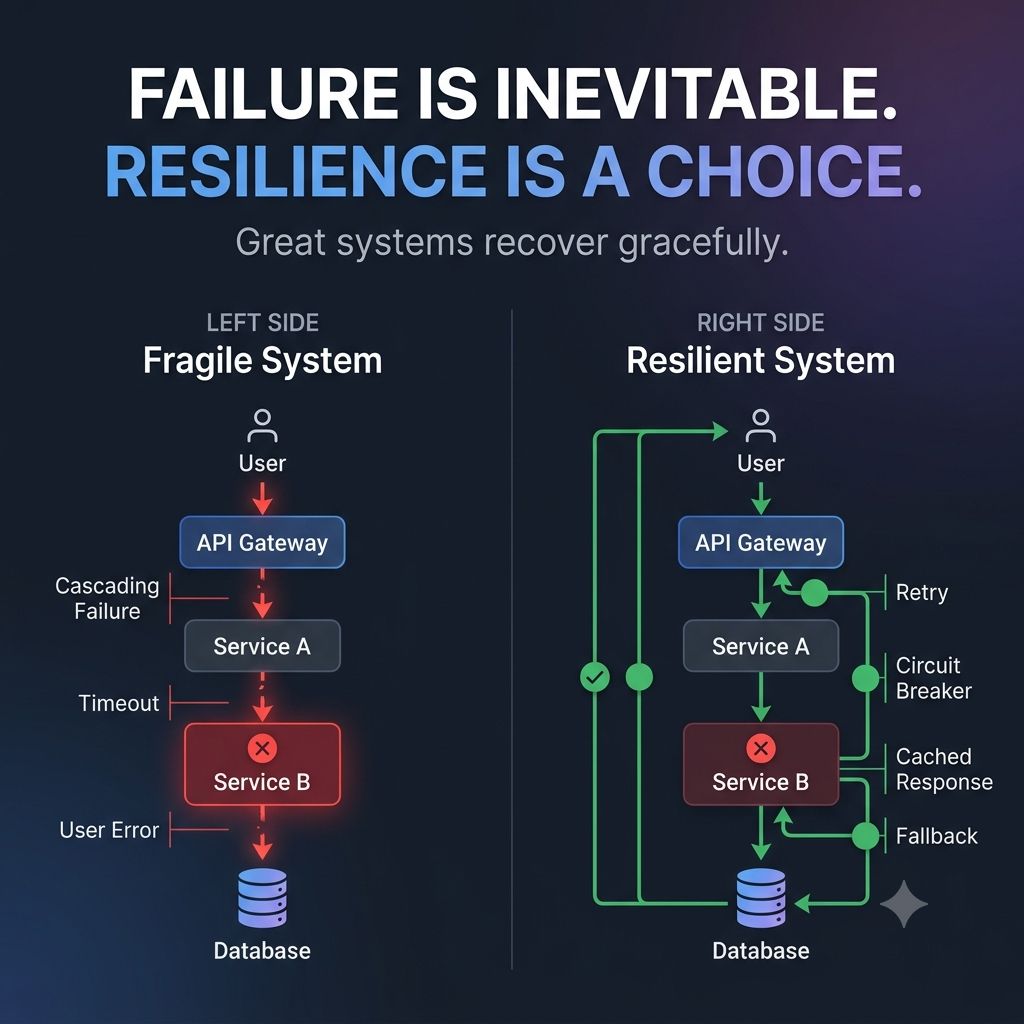
Over time, I've noticed that resilient systems have something in common. They don't panic when a dependency fails. They expect it.
Instead of crashing, they:
- Retry when a failure is likely to be temporary.
- Fall back to cached or default responses when possible.
- Isolate failures so one service doesn't affect everything else.
- Recover gracefully without exposing unnecessary complexity to users.
The result isn't a system that never experiences problems. It's a system that keeps delivering value even when parts of it aren't healthy.
One lesson that has influenced many architectural decisions I've made is this: Reliability isn't about preventing every failure. It's about reducing the impact of failure when it inevitably happens.
That's the difference between software that works in a demo and software that survives production.
Keep reading
The Biggest Architectural Mistake? Optimizing for the Happy Path
Most architectures are designed for everything going right. Why the failure paths deserve as much design attention as the success path.
The Fastest Query Is the One You Never Execute
The dashboards looked healthy, yet users said the app felt slow. The culprit wasn't an expensive query — it was the same query running over and over again.
The Most Dangerous Assumption in Distributed Systems
"This request will only happen once" causes more production incidents than almost anything. Why state-changing actions should assume they may arrive twice.