The Most Dangerous Assumption in Distributed Systems
"This request will only happen once" causes more production incidents than almost anything. Why state-changing actions should assume they may arrive twice.
- Production Lessons
- Idempotency
- Software Architecture
- System Design
One assumption causes more production issues than most engineers realize. "This request will only happen once."
In development, that often feels true. In production, it rarely is.
- Users click twice.
- Browsers retry requests.
- Mobile networks reconnect.
- Load balancers retry failed connections.
- Services resend messages after temporary failures.
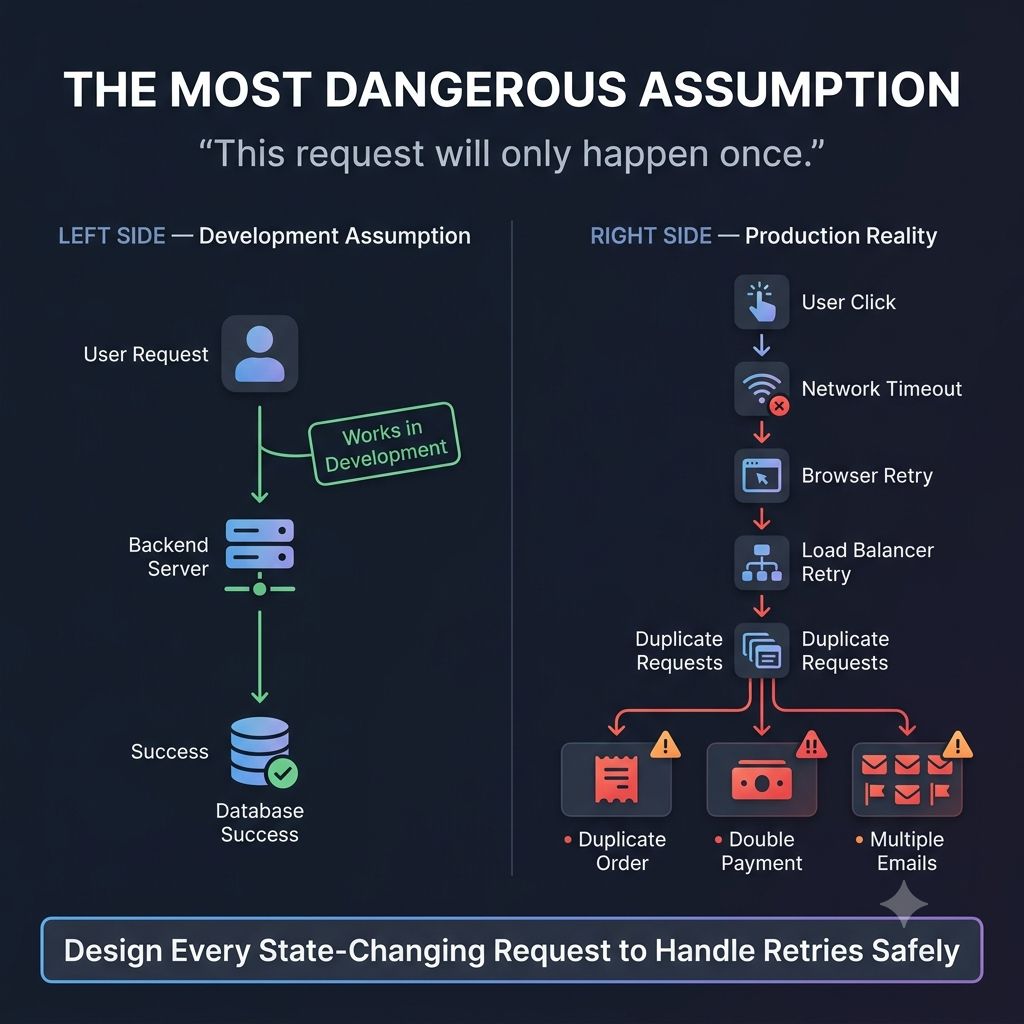
Suddenly, the same operation reaches your system more than once.
If your architecture isn't prepared for that, strange things start happening.
- Duplicate orders
- Double payments
- Multiple emails
- Repeated notifications
- Inconsistent data
One lesson that's changed how I think about distributed systems is this: Every request should be treated as if it might arrive again.
That doesn't mean every operation must be idempotent. Reading a product page is very different from charging a credit card.
But whenever an action changes state, it's worth asking: "What happens if this exact request is processed twice?"
That single question has prevented countless production issues.
Good architecture isn't just about making the first request succeed. It's about making repeated requests safe.
That's one of the biggest differences between software that works in testing and software that survives real-world traffic.
What's one production issue you've seen that was caused by an assumption that turned out not to be true?
Keep reading
The Fastest Query Is the One You Never Execute
The dashboards looked healthy, yet users said the app felt slow. The culprit wasn't an expensive query — it was the same query running over and over again.
How Does Amazon Make Sure You Don't Buy the Same Item Twice?
Refresh the checkout page and you still get one order, one payment, one email. How request identifiers make retries safe at Amazon's scale.
How Does Stripe Avoid Charging You Twice?
Stripe's idempotency keys explained — how a payment API safely handles the same request arriving more than once without charging the customer twice.