How Does WhatsApp Deliver A Message in Milliseconds?
Behind one tap: persistent connections, durable message stores and offline delivery. Why WhatsApp optimizes for never losing a message, not for speed.
- Real System Deep Dive
- Real-Time Systems
- Reliability
- Message Queues
- System Design
- Software Architecture
Sending a WhatsApp message feels simple. You type. You tap send. A second later, it's on someone else's phone.
Behind that single tap is a carefully designed distributed system.
A simplified journey looks something like this:
- 📱 You press Send.
- 🌍 The request reaches the nearest WhatsApp server.
- 🔐 Your identity and session are verified.
- 📨 The message is written to a durable message store.
- ⚡ If the recipient is online, the message is pushed immediately over a persistent connection.
- 📴 If they're offline, the message is safely stored until they reconnect.
- ✅ Once delivered, the sender receives a delivery acknowledgement.
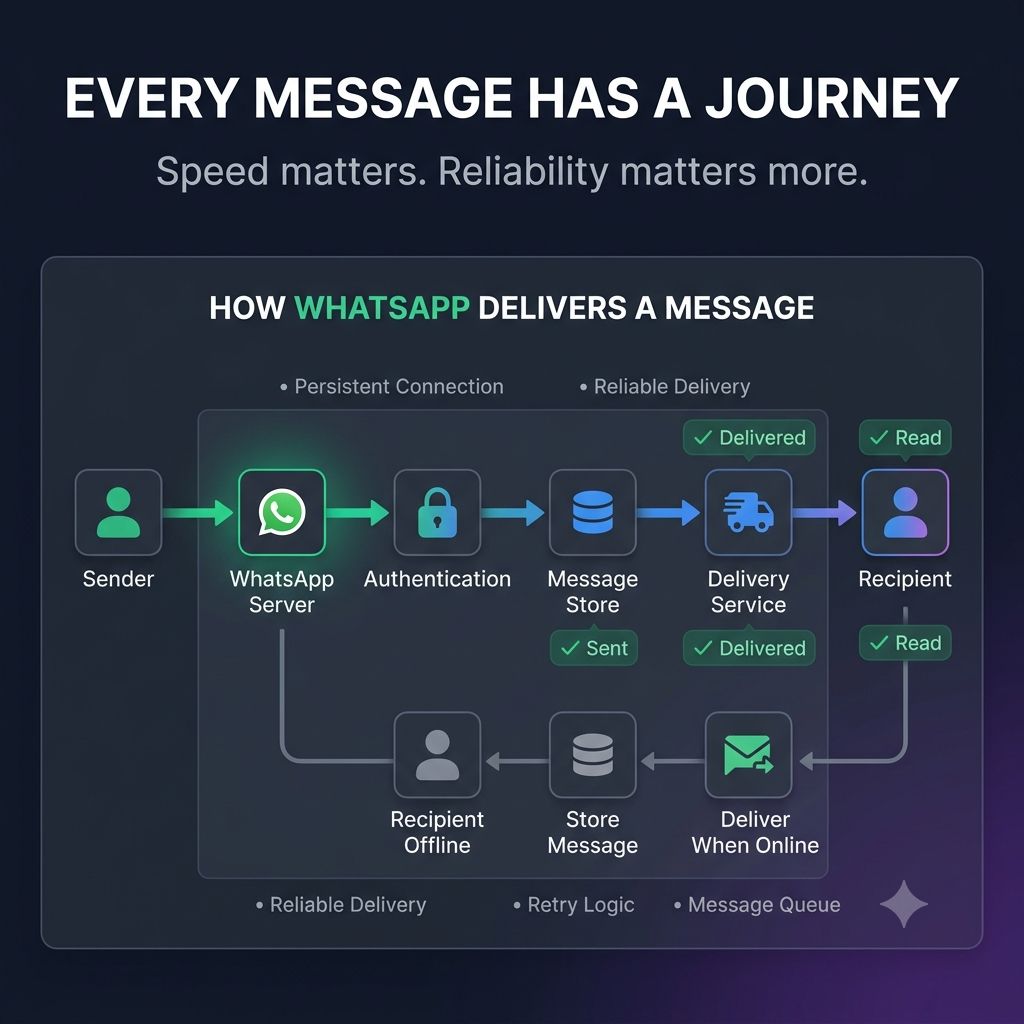
The interesting part isn't just speed. It's reliability.
A messaging platform can't assume both users are online. It can't assume the network is stable. And it certainly can't assume every message succeeds on the first attempt.
That's why systems like WhatsApp are designed around one simple idea: Never lose a message.
Everything else—low latency, delivery status, retries, synchronization—is built around that goal.
One thing I appreciate about large-scale systems is this: The best architecture starts with the most important business requirement.
In WhatsApp's case, that requirement isn't speed. It's trust. If users can't rely on messages being delivered, nothing else matters.
Keep reading
How Does Zoom Keep Your Meeting Alive When Your Network Is Bad?
Adaptive bitrate, audio priority and automatic reconnection — how Zoom optimizes for keeping the conversation alive rather than for perfect video.
How Does Uber Find Your Driver in Seconds?
Geospatial matching, queues and live location updates — how Uber coordinates thousands of decisions per second behind a single tap.
How Does Uber Know Your Driver Moved Without You Refreshing the App?
A driver moves 200 meters and your screen updates without a refresh — the event pipeline, ordering problems, and filtering decisions behind Uber's live location tracking.