How Does Uber Find Your Driver in Seconds?
Geospatial matching, queues and live location updates — how Uber coordinates thousands of decisions per second behind a single tap.
- Real System Deep Dive
- Real-Time Systems
- System Design
- Software Architecture
You request a ride. Within a few seconds, Uber finds a nearby driver and sends them your request. It feels almost instant.
But behind that one tap is a system making thousands of decisions every second.
A simplified journey looks like this:
- 📱 You request a ride.
- 🌍 The request reaches the nearest backend through an API Gateway.
- 📍 Your location is matched with nearby available drivers.
- 📩 A message is placed onto a queue to notify eligible drivers.
- 🚗 Drivers receive the request almost simultaneously.
- ⚡ The first accepted request wins.
- 📲 Both rider and driver begin receiving live location updates.
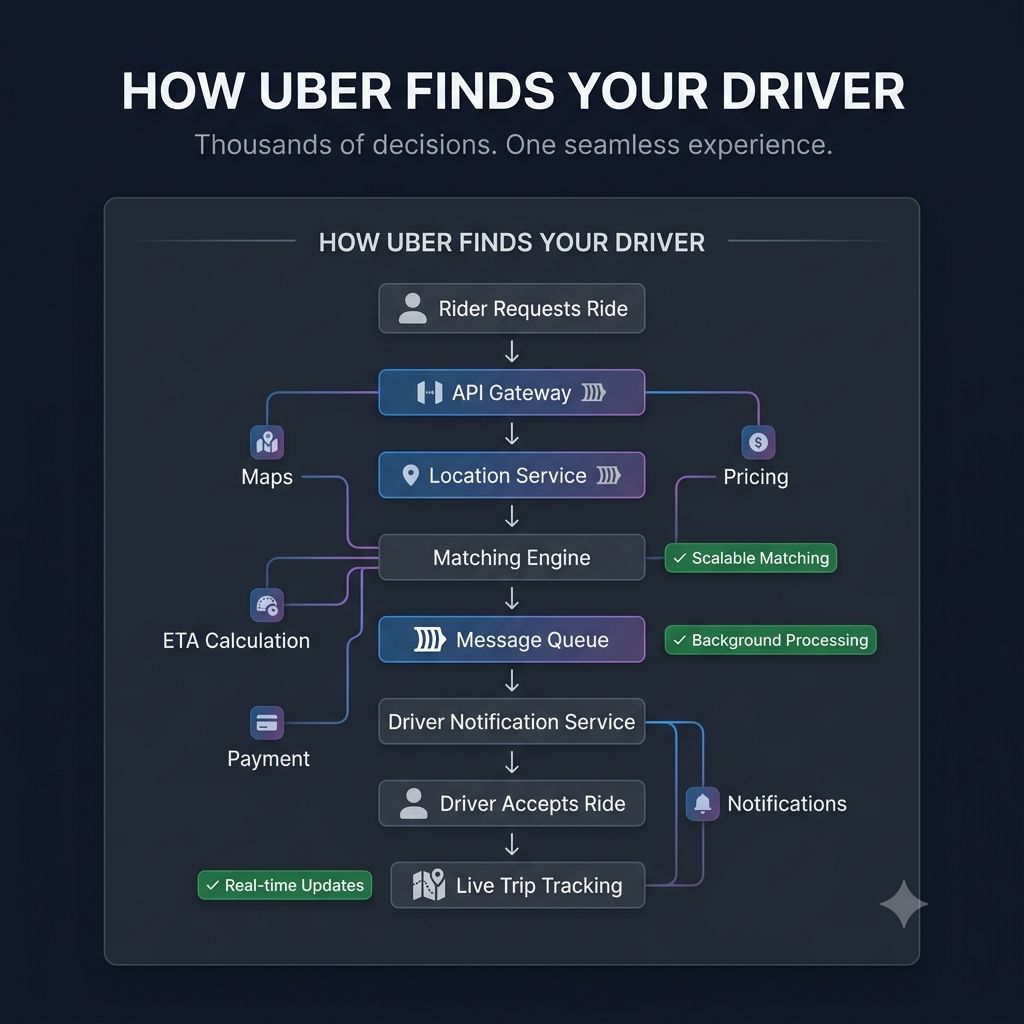
Notice something interesting? Not everything happens synchronously.
- Finding nearby drivers.
- Sending notifications.
- Updating locations.
- Handling cancellations.
These tasks happen independently so the app stays responsive even under heavy traffic.
One thing I've learned from studying systems like Uber: The goal isn't to process everything immediately.
It's to coordinate thousands of moving parts without making users feel the complexity.
That's what good architecture does. It hides complexity behind a simple experience.
When users tap "Request Ride," they don't think about queues, location services, retries, or distributed systems.
They just expect it to work. And that's probably the highest compliment any architecture can receive.
Keep reading
How Does Zoom Keep Your Meeting Alive When Your Network Is Bad?
Adaptive bitrate, audio priority and automatic reconnection — how Zoom optimizes for keeping the conversation alive rather than for perfect video.
How Does WhatsApp Deliver A Message in Milliseconds?
Behind one tap: persistent connections, durable message stores and offline delivery. Why WhatsApp optimizes for never losing a message, not for speed.
How Does Uber Know Your Driver Moved Without You Refreshing the App?
A driver moves 200 meters and your screen updates without a refresh — the event pipeline, ordering problems, and filtering decisions behind Uber's live location tracking.