How Does Netflix Load Your Home Screen So Fast?
Netflix doesn't build your home screen after you open the app — it prepares most of it before you arrive. Why precomputation and caching beat request-time work.
- System Design Explained
- Caching
- Precomputation
- System Design
- Software Architecture
Open Netflix. Within a second, your screen is filled with rows like:
- 🎬 Continue Watching
- 🔥 Trending Now
- ⭐ Top Picks for You
- 🎭 Because You Watched...
It feels instant.
But behind that screen are hundreds of microservices, recommendation engines, metadata stores, and personalization models.
So why doesn't it take several seconds to load?
Because Netflix doesn't build your home screen after you open the app. It prepares most of it before you arrive.
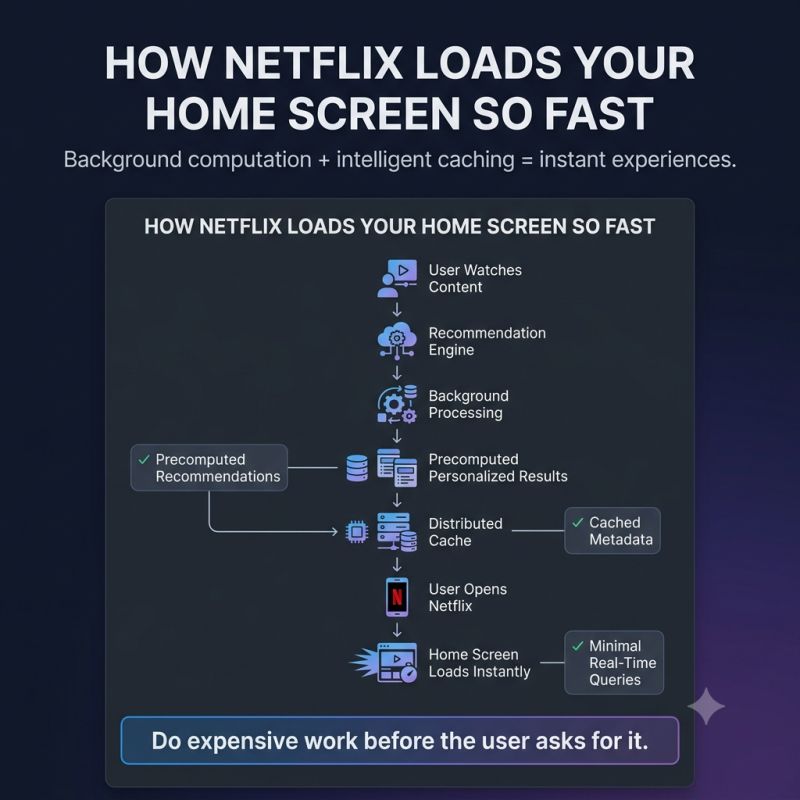
A simplified flow looks like this:
- 👤 You finish watching a movie.
- 🤖 Recommendation systems continuously update your personalized content.
- ⚡ The results are precomputed and stored in fast caches.
- 📱 You open Netflix.
- 🚀 The home screen is assembled mostly from cached data, with only a few real-time requests.
This is an important system design principle: Do expensive work before the user asks for it.
If every recommendation had to be calculated when you opened the app...
- Your home screen would load much slower.
- Recommendation services would receive millions of additional requests.
- The entire platform would become more expensive to operate.
Instead, Netflix shifts much of that work out of the critical request path.
The result?
- Fast responses.
- Lower infrastructure costs.
- A smoother user experience.
One lesson that's changed how I think about system design: Users don't care when the computation happens. They care how quickly the screen appears.
That's why great systems often move work from request time to background processing and intelligent caching.
What's another application you've used that feels instant — even though you know there's a lot happening behind the scenes?
Keep reading
What If Your AI Didn't Need to Generate Text?
The usual AI pipeline — prompt in, text out — breaks down the moment your application needs a decision instead of a paragraph. A typed-question approach can replace an entire generation-and-parsing pipeline.
Why Does Your AI Coding Agent Need to Understand Your Whole Codebase?
An AI coding agent can add role-based access, pass its tests, and still violate the authorization architecture already sitting around it — because writing code is easy, and knowing where it belongs is harder.
Why Doesn't Cloudflare Crash When 20 Million People Open the Same Website?
Millions of people can hit the same website in the same second without it falling over — because most of those requests never reach the origin. How edge caching, rate limiting, and traffic filtering do the real work.