How Does Amazon Make Sure You Don't Buy the Same Item Twice?
Refresh the checkout page and you still get one order, one payment, one email. How request identifiers make retries safe at Amazon's scale.
- Real System Deep Dive
- Idempotency
- E-Commerce
- System Design
- Software Architecture
Imagine you're buying a laptop. You click "Place Order." The page keeps loading.
You aren't sure whether it worked. So you refresh and click the button again.
A few seconds later...
- Only one order appears.
- Only one payment is processed.
- Only one confirmation email arrives.
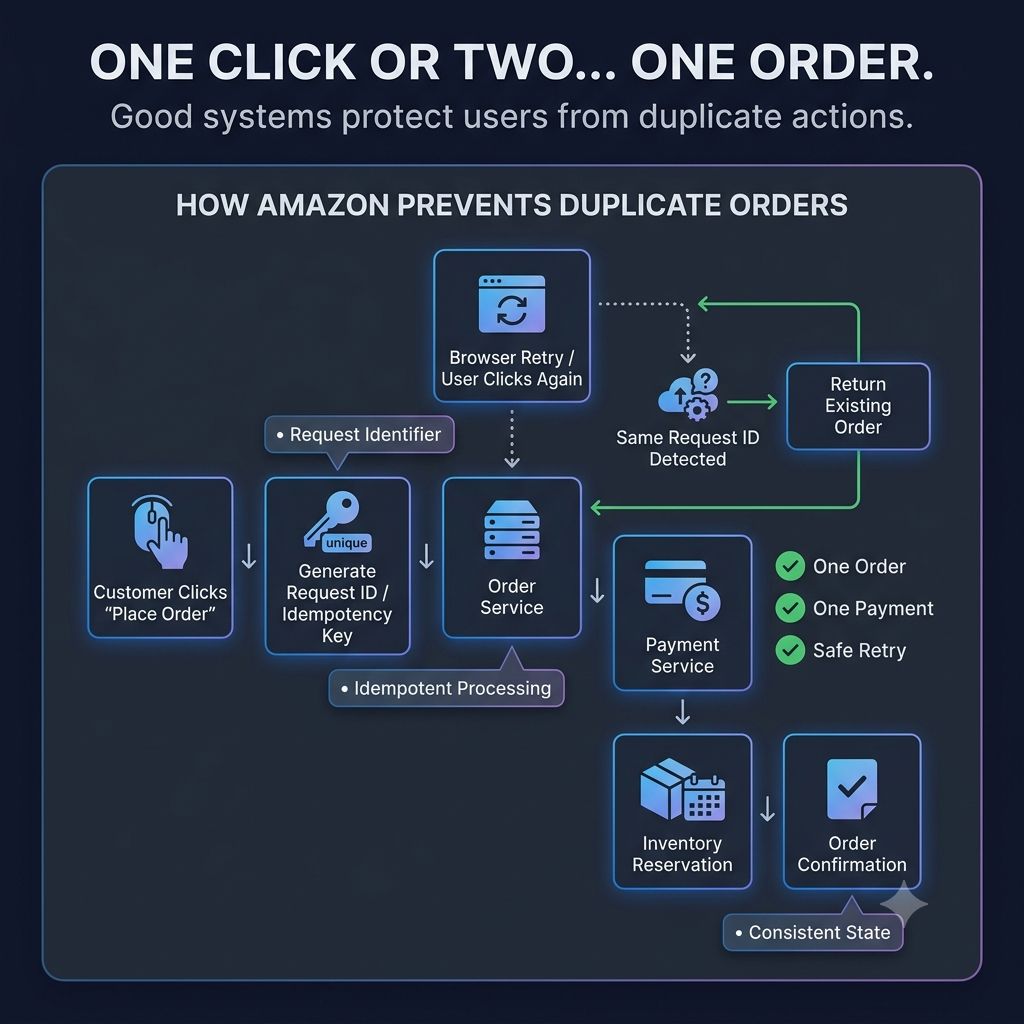
That isn't luck. It's architecture.
A simplified checkout flow looks like this:
- 🛒 You click Place Order.
- 🔑 A unique request identifier is created for the checkout.
- 💳 The payment request is processed.
- 📦 Inventory is reserved.
- 🧾 The order is created.
Now imagine your browser retries the same request because of a timeout. Instead of creating a second order...
The backend recognizes the same request identifier and returns the original result.
- No duplicate payment.
- No duplicate shipment.
- No duplicate order.
This is one of the reasons distributed systems are so fascinating. The user only sees one action.
Behind the scenes, the system may have handled multiple identical requests. One principle I always come back to is this: Users should be free to retry. Systems should be responsible for staying consistent.
That's what separates a feature that works from a platform users can trust.
What's another real-world system you'd like me to break down in this series?
Keep reading
The Most Dangerous Assumption in Distributed Systems
"This request will only happen once" causes more production incidents than almost anything. Why state-changing actions should assume they may arrive twice.
How Does Stripe Avoid Charging You Twice?
Stripe's idempotency keys explained — how a payment API safely handles the same request arriving more than once without charging the customer twice.
How Does Zoom Keep Your Meeting Alive When Your Network Is Bad?
Adaptive bitrate, audio priority and automatic reconnection — how Zoom optimizes for keeping the conversation alive rather than for perfect video.