What actually happens when a user sends a request?
The full journey of a single request — DNS lookup, load balancer, application server, database and back — and why knowing each hop makes debugging far faster.
- System Design Fundamentals
- Backend
- DNS
- Web Architecture
- System Design
- Software Architecture
You click a button.
What happens next is far more complicated than most engineers realize. Let's say you open a website. From a user's perspective, it feels instant. Behind the scenes, a lot is happening.
The browser first needs to find where the application lives.
- A DNS lookup translates a domain name into an IP address.
- The request then travels through multiple network hops before reaching a server.
- The server processes the request, may talk to other services, query a database, and eventually sends a response back.
- Only then does your browser render what you see on the screen.
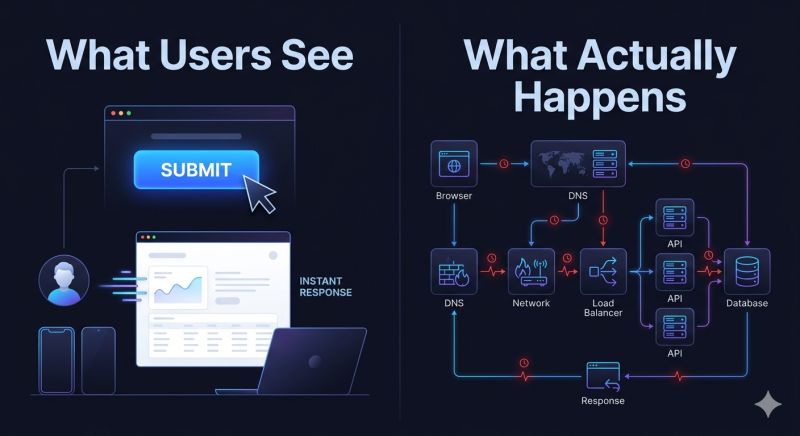
All of this typically happens in a few hundred milliseconds. What's interesting is that every step introduces latency. And latency adds up.
- A slow DNS lookup.
- An overloaded API.
- A database query that's a little slower than expected.
Individually, they don't seem like a big deal. Together, they create the experience your users feel.
One lesson that changed how I think about systems: Users don't care where the delay comes from.
- They only experience the total delay.
- That's why great systems aren't built by optimizing one component.
- They're built by understanding the entire request journey.
Because before you can scale a system, you need to understand how it actually works.
Question: What's the most surprising performance bottleneck you've encountered in a real system?
Keep reading
Every Large-Scale System Is Sacrificing Something
The CAP theorem without the jargon. Every distributed system trades consistency, availability or partition tolerance — the skill is choosing deliberately.
Why Companies Don't Store Everything in One Database
Replication, sharding and read replicas — why large systems split data across many databases, and the trade-offs each strategy forces you to accept.
The Fastest Database Query Is the One You Never Execute
Caching explained from first principles — what to cache, where to put it, and why the cheapest query is the one your database never sees.