One Server Is Never the Problem. One Server Is the Risk
A single server is not a performance problem, it is an availability problem. How load balancing removes the single point of failure before it costs you uptime.
- System Design Fundamentals
- Backend
- System Design
- Software Architecture
A lot of systems work perfectly with a single server. Until that server goes down. Or gets overloaded. Or simply can't handle the traffic anymore.
That's when teams realize they don't have a scaling problem. They have a single point of failure (SPOFs).
Imagine an application receiving 10,000 requests per minute. If every request goes to one server:
- Performance degrades
- Response times increase
- A single outage affects everyone
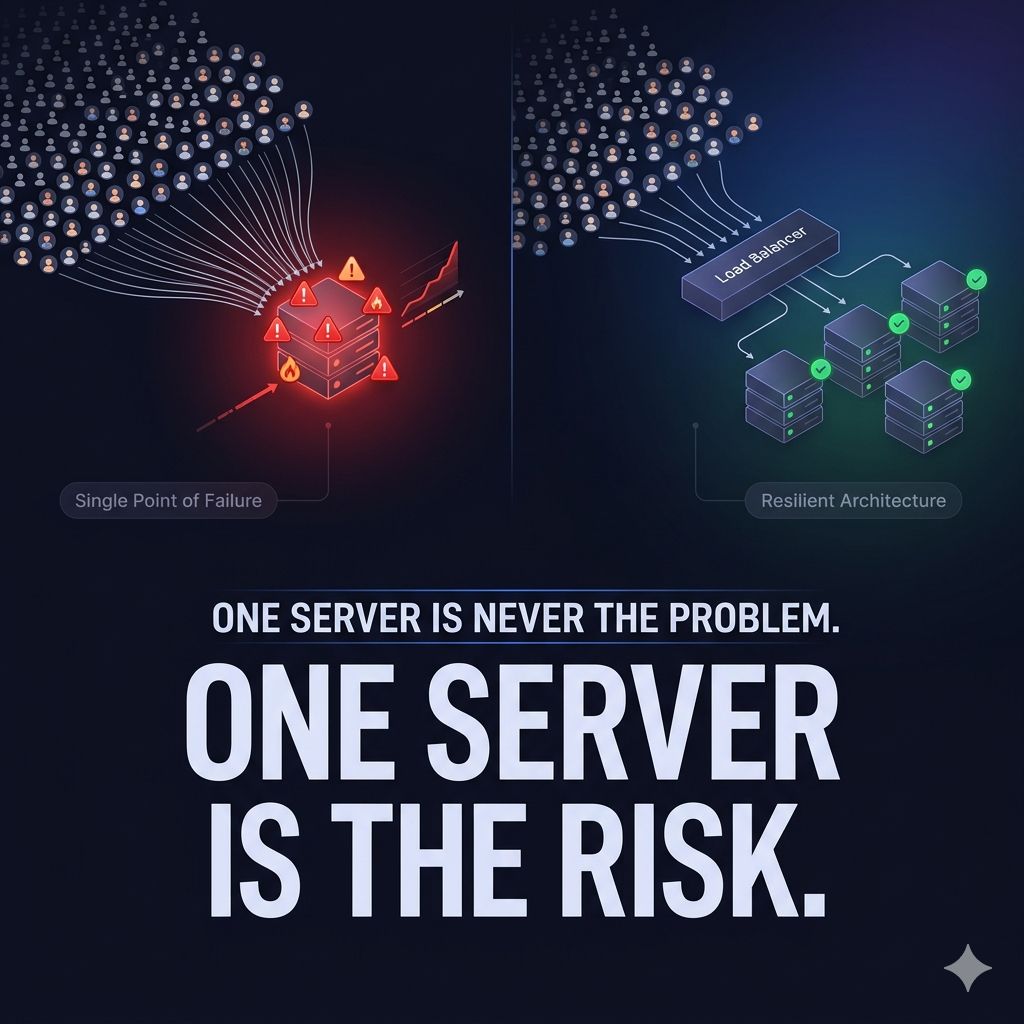
Adding a bigger server might help for a while. But eventually you'll hit the same wall again.
This is where one of the most important System Design concepts comes in: Load Balancing.
- Instead of sending every request to a single machine, traffic is distributed across multiple servers.
- Now if one server struggles, the others can continue handling traffic.
- The goal isn't just performance. It's resilience.
One shift that changed how I think about architecture: Scaling isn't about adding more servers.
It's about removing single points of failure. Because in production systems, the question isn't:Will something fail? It's:• What happens when it does?
That's where good System Design begins.
Question: What's the biggest single point of failure you've encountered in a real system?
Keep reading
Every Large-Scale System Is Sacrificing Something
The CAP theorem without the jargon. Every distributed system trades consistency, availability or partition tolerance — the skill is choosing deliberately.
Why Companies Don't Store Everything in One Database
Replication, sharding and read replicas — why large systems split data across many databases, and the trade-offs each strategy forces you to accept.
The Fastest Database Query Is the One You Never Execute
Caching explained from first principles — what to cache, where to put it, and why the cheapest query is the one your database never sees.