How Does YouTube Serve Billions of Videos Without Melting Down?
Millions press Play at the same time, yet videos start in seconds. How edge servers and distributed caching move content closer to you instead of making you wait.
- Real System Deep Dive
- CDN
- Caching
- Distributed Systems
- System Design
Every minute, hundreds of hours of video are uploaded to YouTube.
At the same time...
Millions of people are pressing Play.
Imagine if every viewer had to stream every video directly from one central server. The internet simply wouldn't keep up.
So how does YouTube make videos start playing in seconds? Not by building one massive server. By making the content travel closer to you.
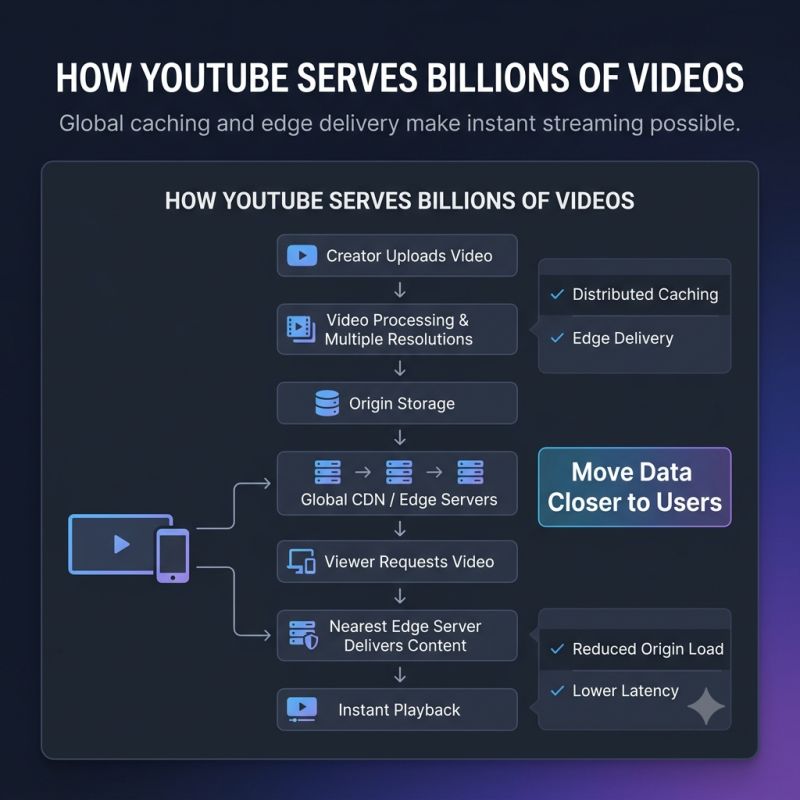
A simplified flow looks like this:
- 🎥 A creator uploads a video.
- ⚡ The video is processed into multiple resolutions (360p, 720p, 1080p, 4K...).
- 🌍 Popular videos are replicated across data centers and edge locations around the world.
- 📱 When you press Play, you're usually served by a nearby edge server — not the original storage system.
- 🚀 The video starts quickly while reducing the load on YouTube's core infrastructure.
This is one of the most powerful ideas in distributed systems: Move data closer to users instead of making users wait for distant data.
Caching isn't only about databases.
It's everywhere.
- Video content
- Images
- API responses
- Application assets
- Recommendations
The closer frequently accessed data is to the user, the faster the experience feels.
One principle I always come back to is this: Scaling isn't always about adding more servers. Sometimes it's about serving the same data smarter.
That's why platforms like YouTube rely heavily on distributed caching and content delivery rather than asking their origin systems to handle every request.
What's another application that feels instant because of smart caching rather than raw computing power?
Keep reading
How Does Netflix Know Something Is Broken Before You Do?
Thousands of services sit behind a single "Press Play" — how Netflix connects metrics, logs, traces, and client telemetry to catch playback failures before users report them.
How Does Uber Know Your Driver Moved Without You Refreshing the App?
A driver moves 200 meters and your screen updates without a refresh — the event pipeline, ordering problems, and filtering decisions behind Uber's live location tracking.
Why Doesn't GitHub Stop Working When Everyone Pushes Code at the Same Time?
Millions of developers pushing, pulling, cloning, and opening pull requests at once, and GitHub keeps serving repositories. How each layer, from CDN to caching to background queues, protects the one behind it.