7 Days, 7 System Design Fundamentals
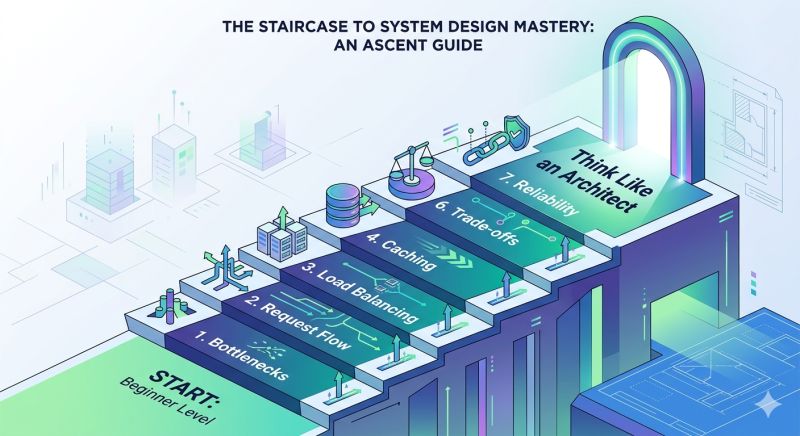
Seven core system design ideas — bottlenecks, request flow, load balancing, caching, databases, trade-offs and reliability. Practical, not interview theory.
- System Design Fundamentals
- Scalability
- Backend
- Frontend
- System Design
- Software Architecture
A few years ago, I realized something interesting. Many engineers work on systems that serve thousands (or millions) of users. Yet a lot of us never formally learn System Design.
We pick things up along the way:
- a database bottleneck here
- a caching problem there
- a production outage that teaches a lesson you'll never forget
That's how I learned most of it too. Not from textbooks. From building, breaking, debugging, and scaling systems.
So over the next 7 days, I'm going back to the fundamentals.
- Not interview-style System Design.
- Not complex architecture diagrams.
Just the core ideas that show up repeatedly in real systems:
- Bottlenecks
- Request Flow
- Load Balancing
- Caching
- Databases
- Trade-offs
- Reliability
The goal is simple: Break down one concept each day in a way that's practical, easy to understand, and grounded in real-world engineering.
If you're an engineer looking to strengthen your system design thinking, feel free to follow along.
Day 1 drops tomorrow.
Let's see where the discussion takes us.
Keep reading
Every Large-Scale System Is Sacrificing Something
The CAP theorem without the jargon. Every distributed system trades consistency, availability or partition tolerance — the skill is choosing deliberately.
Why Companies Don't Store Everything in One Database
Replication, sharding and read replicas — why large systems split data across many databases, and the trade-offs each strategy forces you to accept.
The Fastest Database Query Is the One You Never Execute
Caching explained from first principles — what to cache, where to put it, and why the cheapest query is the one your database never sees.